Witness Preparation

Witness Preparation

Personal Injury Trial
Jury Selection
Mauris quam lacinia semper mollis nulla venenatis; blandit class. Metus vivamus dui ante congue diam lacinia elit lobortis.


Mauris quam lacinia semper mollis nulla venenatis; blandit class. Metus vivamus dui ante congue diam lacinia elit lobortis.
📍 KEY MOMENTS
🧰 PJI HIGHLIGHTS FOR YOUR REFERENCE
Trial Bible EP 3 Peter Kolp – WORKING EDIT
===
[00:00:00]
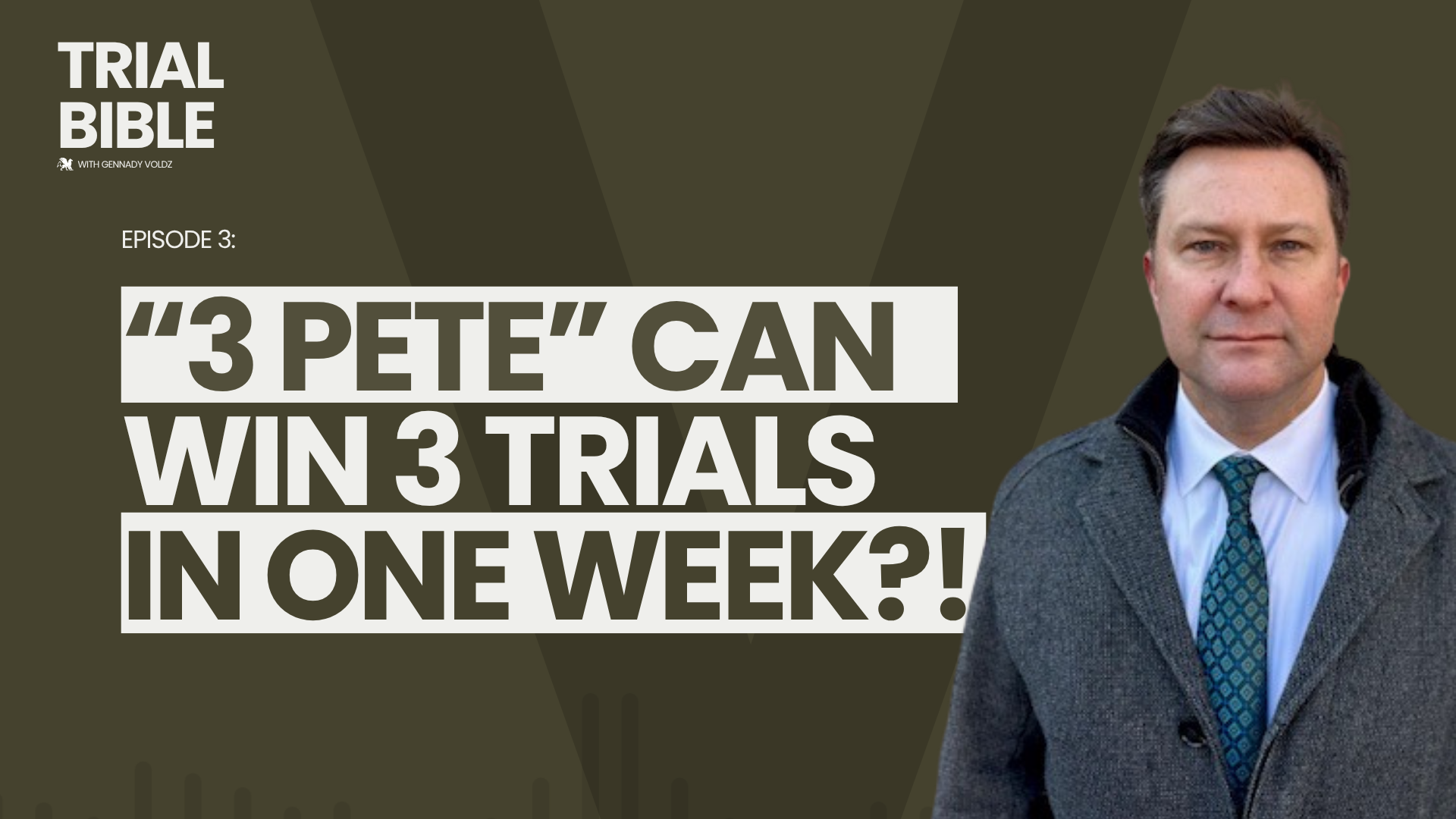
[00:00:32] Gennady Voldz: Welcome back everyone to the trial [00:00:35] Bible where we crack open the law, drop some legal knowledge, and have a little bit of fun along [00:00:40] the way. I’m your host, Gennadi Volz, and today we’ve got a true legal [00:00:45] powerhouse on the show. Someone who can get a verdict faster than you can say, [00:00:50] summary jury trial. He’s a litigator with lightning speed, a courtroom closer, [00:00:55] and the master of the one day trial.
[00:00:57] Gennady Voldz: Peter Culp, welcome How, how [00:01:00] are you? ...
Trial Bible EP 3 Peter Kolp – WORKING EDIT
===
[00:00:00]
[00:00:32] Gennady Voldz: Welcome back everyone to the trial [00:00:35] Bible where we crack open the law, drop some legal knowledge, and have a little bit of fun along [00:00:40] the way. I’m your host, Gennadi Volz, and today we’ve got a true legal [00:00:45] powerhouse on the show. Someone who can get a verdict faster than you can say, [00:00:50] summary jury trial. He’s a litigator with lightning speed, a courtroom closer, [00:00:55] and the master of the one day trial.
[00:00:57] Gennady Voldz: Peter Culp, welcome How, how [00:01:00] are you?
[00:01:00] Peter Kolp: I, I can’t wait to
[00:01:02] Peter Kolp: meet this guy you just introduced.
[00:01:04] Gennady Voldz: so [00:01:05] excited to have you on the show personally, because I know you as a good friend, but [00:01:10] also because I love these summary jury trials and you are the [00:01:15] guy that needs to tell our audience all about them. And there’s a very [00:01:20] specific reason why I have you on this show.
[00:01:22] Gennady Voldz: You’ve built quite the reputation for [00:01:25] being a speedster in the courtroom, especially when it comes to these one day trials. [00:01:30] And I’m gonna be the one that says it right off the bat. You have [00:01:35] won three trials in one week each [00:01:40] six figure awards, and that was just a few months ago. So we’re gonna [00:01:45] coin the term threepeat on officially,
[00:01:49] Peter Kolp: Yeah, [00:01:50] I mean, you have to get the right judges who are willing to do ’em in
[00:01:53] Peter Kolp: a day. Most are, some [00:01:55] want to do it for two days, but, uh, judge Barbado up
[00:01:58] Peter Kolp: in the Bronx will do it [00:02:00] before, uh, lunchtime. So it’s just a matter of keeping the facts straight.
[00:02:04] Gennady Voldz: I’ve been in [00:02:05] front of, uh, judge Barbado. You’re, you’re getting a verdict before 12 o’clock with him. [00:02:10] when you’re starting in the morning.
[00:02:12] Peter Kolp: he was actually very disappointed that mine went [00:02:15] after, uh, after one o’clock. So we had to take a lunch [00:02:20] break. Um, but I, it was because the jury didn’t come in in time. He usually starts right at nine [00:02:25] 30. You got a jury ready to go and, um, he does some of the jury selection, and then you, [00:02:30] you jump in.
[00:02:31] Gennady Voldz: So today we’re gonna dive into what makes a summary jury trial so [00:02:35] unique in New York, how you’ve been able to ace them the way you’ve been doing, [00:02:40] you’ve been very successful with them. Uh, and we’d like to look at the three [00:02:45] trials that you handled in that one week and kind of break down the how and why of each of [00:02:50] those victories.
[00:02:51] Gennady Voldz: So, buckle up folks. We’re gonna be speeding through this one. [00:02:55] so before we even get to it, Pete, I want you to explain to someone [00:03:00] most of our listeners are attorneys, but some aren’t. What is a summary jury [00:03:05] trial?
[00:03:05] Peter Kolp: Yeah, so a summary jury trial, if there liability and damages, [00:03:10] is just taking
[00:03:11] Peter Kolp: all the experts in doctors that you have and putting it [00:03:15] into packet. It’s a numbered packet, so your typically, your [00:03:20] police reports going in there, all your medicals, your operative report. You put it in [00:03:25] one packet and the defense has another packet.
[00:03:27] Peter Kolp: And before the trial, you have an [00:03:30] evidentiary hearing to either stipulate or hammer out all the packets. [00:03:35] and so. They, they are set usually one to 12 exhibits, [00:03:40] and then when you go in for a summary jury trial, you’re, you’re picking a [00:03:45] jury and you have your exhibits. Plaintiff and, and defendant typically testify.
[00:03:49] Peter Kolp: And that’s [00:03:50] it.
[00:03:50] Gennady Voldz: So for those of you listening in New York. Summary jury trial, you’re going to [00:03:55] agree with the other side to parameters. This is a binding trial. This not [00:04:00] like mediation. It’s a binding trial where you agree to a high low, [00:04:05] and that’s, uh, what the, the verdict will be limited to what that high low [00:04:10] is. Um, in addition to that, there’s time restraints here, right?
[00:04:14] Gennady Voldz: Uh, [00:04:15] typically almost all the judges will hold you to these time restraints, which is 10 [00:04:20] minutes for opening for each side, an hour to present your [00:04:25] case, and 10 minutes for closing. Does that sound
[00:04:27] Gennady Voldz: about right? Pete,
[00:04:28] Peter Kolp: Yeah, that’s
[00:04:29] Peter Kolp: dead [00:04:30] on.
[00:04:30] Gennady Voldz: what about jury selection? Is there a time period for
[00:04:33] Gennady Voldz: that?
[00:04:34] Peter Kolp: Yeah, you [00:04:35] got an hour. So, and that includes def defense and plaintiff [00:04:40] and certain, uh, jurisdictions that really hold you to the hour. [00:04:45] Barbado, he does most of it himself and gives you maybe 10 minutes. Um, so it depends on the [00:04:50] judge. I knew they’re doing it across the country now. I know Arizona’s starting to do ’em.[00:04:55]
[00:04:55] Peter Kolp: Um, I’m not sure any other jurisdictions, but that’s, them’s the [00:05:00] rules, them’s the rules of the game summary jury trial game.
[00:05:03] Gennady Voldz: 10 [00:05:05] minutes for jury Sounds insane. So [00:05:10] Pete, you have about an hour to select your jury. What kinds of things are you [00:05:15] going through with them and how are you doing it quickly enough to [00:05:20] figure out who’s going to be on your side and who isn’t?
[00:05:23] Peter Kolp: I always do, [00:05:25] there’s about three or four things I always do and I part [00:05:30] of me hesitates. ’cause like when you talk about these things, they sound gimmicky, but they are [00:05:35] always my intro just ’cause I believe it sets this stage and [00:05:40] I. We’ll pull out this [00:05:45] Their jury cards. and I’ll say, you all went to [00:05:50] your mailbox at some point in the last few months and you said, [00:05:55] yes, the golden ticket I have won. I’m in jury [00:06:00] And I feel like the jurors realized right away, okay, this is not your [00:06:05] typical like boring attorney. And I say, listen, I know that’s not what you did. ’cause when I got it [00:06:10] during COVID, I wasn’t excited that you got, you have [00:06:15] lives, you have work. This is not something you wanna do. You don’t wanna call in work for this. So [00:06:20] I get it. And I asked them, [00:06:25] can you tell me or anybody have a guess what the number one thing that uS [00:06:30] attorneys get asked, and I’ll ask you gdi, what’s the number one thing you get [00:06:35] asked as an attorney just in
[00:06:36] Gennady Voldz: How do I get off jury duty?
[00:06:38] Peter Kolp: [00:06:40] Yes. And, and frankly, nobody, I, I think maybe of [00:06:45] all the times a hundred plus trials I’ve had, I think one person gets that. Usually [00:06:50] they say, can you help me with wills? Can you help me with state? But I tell ’em that’s [00:06:55] what, that’s what we get asked as attorneys, how do I get off jury duty? What do I say? What can I [00:07:00] tell ’em? Can I tell them that I know you can, I can I tell ’em I hate all personal [00:07:05] injury cases. Can I tell? And I genuinely, I, I mean [00:07:10] I tell everybody, don’t, because [00:07:15] I know people say next to voting, this is the most important thing. But let me tell [00:07:20] the, the story is back when we came over from Britain, [00:07:25] we had a king and he had his three judges or [00:07:30] whatever in the courtyard, and, and you’re smiling, so maybe you’ve heard this story, but [00:07:35] I always say. The king said, okay, judges, this is how I wanted the case to [00:07:40] go. And on Friday you get your gold. So the case is gonna go the way [00:07:45] I want it to go. Isn’t it judges? Yes. King. We like our gold, we want it to go this way. [00:07:50] So I tell friends and family and people that ask, so don’t, the [00:07:55] reason we came over here and we fought for this, is we’re the only country in the [00:08:00] world that has juries for civil cases. So, um, [00:08:05] and the reason we do that is because we don’t want a king deciding how our cases are gonna go. [00:08:10] And so we have six jurors decide our cases and it’s [00:08:15] important. And I know you weren’t excited when you got this little, you know, golden ticket, [00:08:20] but that’s why we have it. Is everybody okay with that concept and I think that’s
[00:08:24] Gennady Voldz: [00:08:25] the beauty of what you just said and did is one, you’re becoming [00:08:30] very relatable very quickly with that. Here’s the ballot, and this [00:08:35] is the golden take. They immediately understand that you understand. They [00:08:40] don’t wanna be here. That makes relatable to
[00:08:42] Gennady Voldz: them, but then you also follow up with the [00:08:45] significance of what it is that they’re doing there.
[00:08:47] Gennady Voldz: now do you mention to them [00:08:50] that this is a one day trial? Do you, do you talk about, uh, anything [00:08:55] to do with this will be a limited scope?
[00:08:57] Gennady Voldz: see in here.
[00:08:58] Peter Kolp: yeah, it’s important ’cause [00:09:00] you also see ’em light up and I’ll say, um, listen, if you’re gonna [00:09:05] be on jury duty, this is the case to be on because my, my client has agreed to [00:09:10] this pilot program. That’s a summary jury trial, and you’re gonna be outta [00:09:15] here by four 30. The only reason you would not be done by four [00:09:20] 30 is if you’re still deliberating, the judge is not gonna cut you off. [00:09:25] So most of the time they’ll have the case by 2, [00:09:30] 2 30 or uh, in the Bronx by like 12 o’clock. But I’ll tell them, if you’re [00:09:35] gonna be on jury duty, this is the case you wanna be on. And then I have to talk to about them, [00:09:40] about in jury selection. I’ll show ’em a packet and I’ll say, [00:09:45] there are some people who say, I need to see each of these [00:09:50] witnesses. You have seven doctors there. I want to see them on the stand and [00:09:55] look at them. There are other people who say I, if they’re gonna just say what’s in the [00:10:00] reports and those exhibits, and they, if they took the sand, they would say, what’s in those [00:10:05] reports? Then I’m okay with that. I’d rather not waste the time of somebody coming in [00:10:10] testifying and spending several hours. So I, I tell ’em right up front that this is [00:10:15] the type of case and that they want to be on this case.
[00:10:17] Gennady Voldz: I like to ask them, is it okay with [00:10:20] you if I bring this case to you as quickly as I can? Is it with you if [00:10:25] I make you a promise that if I call any witness it won’t be more than 20 minutes? [00:10:30] Is that okay with you? and gets them
[00:10:33] Gennady Voldz: excited [00:10:35] to wanna be there.
[00:10:36] Gennady Voldz: Are you ever mentioning how [00:10:40] making sure that just because this is a one day trial doesn’t mean it’s not a significant case? [00:10:45] It doesn’t mean that we’re not gonna be asking for a lot of money.
[00:10:48] Peter Kolp: Yeah. Yeah. I think [00:10:50] you have to say, you know, just because the, essentially what you [00:10:55] just said with the, with the caveat that just because it lasts a day, it’s just as [00:11:00] serious, uh, case as anybo any other case in the courtroom, but they’ve agreed to this pilot [00:11:05] program to expedite the case.
[00:11:07] Gennady Voldz: 10 minutes for opening an hour to [00:11:10] present, including putting on any witnesses going through your packet, [00:11:15] 10 minutes to close. It’s like the speed dating version of a full blown [00:11:20] trial.
[00:11:20] Peter Kolp: It really is. Right. I, and listen, I guess we should say is [00:11:25] I’m sure there’s people listening to this and they’re like, well, why would, why would anybody agree to [00:11:30] this? And I guess it’s important to say the, on both sides, you’re [00:11:35] eliminating paying an expert. Five to 12, 14, [00:11:40] $16,000. So both sides are cutting out that aspect of the case. [00:11:45] The insurance companies, because of the high low that you mentioned, they’re [00:11:50] capping their, capping the case that their policy, so [00:11:55] they’re happy. The client, I’m telling, listen, you’re gonna save 10 [00:12:00] grand on an expert coming in to try and you’re gonna case is gonna be done in a day as opposed [00:12:05] to what could be a week, two weeks trial. So both [00:12:10] sides have, a benefit of agreeing to these s [00:12:15] jts. I know also a lot of firms will say, ah, but I don’t want to do this. I want the [00:12:20] sky as the limit. But, and maybe, you know, listen, we you we’re both smiling. [00:12:25] There are cases where it’s not right. Right. If you have a huge policy, but [00:12:30] even then you may wanna put a decent low. And a high and, and bracket it off. But [00:12:35] most people want their doctors in those huge cases.
[00:12:37] Gennady Voldz: So this is one of the [00:12:40] most talked about conversations that I have with firms that I work [00:12:45] with, and I’m sure you do too, is ultimately deciding is this the right [00:12:50] case for an SJT? And kind of figuring out do we do this as an [00:12:55] SJT or not? And what I’ve been experiencing is most, uh, a lot of [00:13:00] firms are skeptical of the SJT one day trial.
[00:13:03] Gennady Voldz: They’re skeptical when there’s [00:13:05] a large policy, a million plus policy, and they say, I [00:13:10] don’t really see a jury awarding that kind of money on a one
[00:13:14] Peter Kolp: Yeah, [00:13:15]
[00:13:16] Gennady Voldz: And the way I have been talking to. These [00:13:20] attorneys is, this is if the matter is simple enough. If the issue [00:13:25] here is simple enough, there is no need for a full [00:13:30] blown trial if this is a simple liability case or a [00:13:35] simple damages where you just know what the injury is and you know what we’ve gotten very good [00:13:40] at isolating what it is.
[00:13:41] Gennady Voldz: The issue is in these cases, [00:13:45] um, that the jury needs, are both living proof and others as [00:13:50] well that you could hit big on these s jts. We are now doing [00:13:55] parameters of two 50 on the bottom and a million on the [00:14:00] top, and that is now the new norm. That’s why I am so this for us [00:14:05] episode
[00:14:06] Gennady Voldz: to talk about.
[00:14:08] Gennady Voldz: We are easily [00:14:10] getting six figures on these one day trials now that we’ve kind of figured out, you know, our way [00:14:15] and how to present the injuries in a very quick and to the point. Uh, [00:14:20] way to this jury. Would you agree?
[00:14:22] Peter Kolp: a hundred percent in even more so [00:14:25] Kanati. Look, look at the way the world’s going. Right. the attention span of [00:14:30] people is small. Like they don’t wanna spend two weeks in a jury box, [00:14:35] right?
[00:14:35] Peter Kolp: I have an 11 and an 8-year-old. You think he’s paying attention in a [00:14:40] two, three week trial. When he’s eligible in seven years from now, he’s gonna be [00:14:45] crawling the walls. This is, I think s jts are the future of, [00:14:50] of cases. I think people that think otherwise are, are not [00:14:55] appreciating what’s going on in our world in terms of the attention spans and whatnot. [00:15:00] But I get, listen, there’s hesitation.
[00:15:02] Peter Kolp: I want my expert explaining [00:15:05] to a jury. You and I both know that, both that. That [00:15:10] every juror that we’ve talked to will either say, will say, three things. [00:15:15] I heard both experts and they both canceled each other. Right. How many [00:15:20] times have you heard that? Like, and you’re like, how could you say that we spent so much time?
[00:15:24] Peter Kolp: That’s how they [00:15:25] see it.
[00:15:25] Gennady Voldz: By the way, I’ve heard of that one So much that now it’s a mandatory question for me in [00:15:30] my jury selection. Do you that just because experts are gonna come before you [00:15:35] and say to give two very different opinions, does that cancel each [00:15:40] other out? Or are you able to use your common sense [00:15:45] and focus on the evidence that’s being presented and judge each [00:15:50] expert like you do the witnesses and judge their credibility and judge their opinion?
[00:15:54] Gennady Voldz: How do you [00:15:55] feel about that? And I started doing that now on all my cases because I’ve heard that one so much.
[00:15:59] Peter Kolp: [00:16:00] no, that’s a good one. I’ve heard, uh, that, or I’ll say in [00:16:05] think take the stand, swear to tell the truth, nothing but the truth, but [00:16:10] because what’s, you know, and, uh, I gesture to make it very clear because of [00:16:15] what’s going in their pocket, that they may have a, a, a skewed view. I want you to pay [00:16:20] really close attention to the defense doctor in this case. But, [00:16:25] but I think that’s the biggest hesitation. Looping back to what you were talking about. It’s the hesitation with [00:16:30] firms. No, we want him to hear our doctor ’cause he’s good. And the reality, I think is [00:16:35] it really comes down to our cross-examination of the defense doctor [00:16:40] or the plaintiff doctor.
[00:16:42] Peter Kolp: You put it on paper, most jurors cancel it out. [00:16:45] So that’s why I think these S jts are really cut to the chase. It’s the, i, I [00:16:50] really believe this is future. Um, and more and more [00:16:55] states are starting to adopt it. And, and I just talked to folks from Arizona and they’re like, yeah, we have [00:17:00] it on the books, but we don’t use it. So I’m going out there to do a talk with them and it’s like [00:17:05] to tell ’em this, this is the way things are gonna go.
[00:17:08] Gennady Voldz: I’ll add to your point, [00:17:10] you know, the firms are saying we want our experts to talk about it. If you’re a [00:17:15] really good trial lawyer, you know the medicine inside and out.
[00:17:19] Gennady Voldz: it’s a beautiful [00:17:20] thing to be able to have full control in what it is the jury’s hearing. And [00:17:25] because such a short period of time, they’re tuned in, they’re listening to you. We are, you know, [00:17:30] I like the fact that you said the kids have, you know, less and less attention. S [00:17:35] jts are the TikTok world of trials.
[00:17:39] Peter Kolp: yeah, [00:17:40] yeah. Oh gosh. Now that’s terrible, right? But, but listen, it’s just our [00:17:45] reality. You think like 10 years from now, people just aren’t gonna have their attention span, right? [00:17:50] So I feel like if you’re an attorney out there, get on board with the S jts. I know [00:17:55] Joe Free and a couple other guys call them speed trials. So they don’t do s [00:18:00] jts, but they try to condense things even though they don’t have summary jury trials, [00:18:05] they try to condense them into the smallest, tightest package. Like you said,I’m gonna do [00:18:10] a direct in 20 minutes,
[00:18:11] Peter Kolp: to those attorneys listening that don’t have s jts in their, in [00:18:15] their states or territories. You have to understand that the packets that Pete is [00:18:20] talking about, it’s not just the medical records, but there are exhibits that [00:18:25] you exchange with the other side. These are agreed on packets that include medical [00:18:30] definitions, that include medical diagrams.
[00:18:33] Gennady Voldz: and we’re gonna go through some of those [00:18:35] diagrams that you’ve used in the cases that, that you’ve just recently won. But it’s really a [00:18:40] beautiful thing if you know your issues, you know how to get to your points and you [00:18:45] know what you need to win. So I do wanna turn to the [00:18:50] three-peat, uh, that you to able to achieve and kind of go [00:18:55] through these cases to give people a really good idea of how it is that you get [00:19:00] six figures on these one day trials.
[00:19:02] Peter Kolp: [00:19:05] Yeah, listen, it’s, and I’ve had people ask like, why would you set that up? [00:19:10] It’s just, it’s too much and you’re not giving it time and attention [00:19:15] with, as we’ve come outta COVID courts are pushing these cases so much [00:19:20] that. You, you know, you’re having it too. So it’s, it’s not that unusual, but they line [00:19:25] these up and I had the judges say, we’re not moving it just because you have a trial on wednesday. [00:19:30] We’re not moving it ’cause you have a trial on Thursday. So they were like, you’re doing [00:19:35] these. And, and I had one other where it, I tried to threepeat and I won the first two and I [00:19:40] lost the third one so it didn’t count. So, So, that’s, that’s a [00:19:45] little bit of the context. I know people would say, well that’s not fair to your clients or were you doing this just to get the [00:19:50] threepeat?
[00:19:50] Peter Kolp: And yeah, I thought, I did think it was fun. I did, [00:19:55] but
[00:19:55] Gennady Voldz: me a law firm owner that would say no. To [00:20:00] three six figure trial verdict wins in one [00:20:05] week.
[00:20:05] Peter Kolp: In hindsight though, ti like it, they might say on that Tuesday [00:20:10] before I started, like, how are you gonna get these straight? You’re not gonna be able to win these all, you’re not gonna be able to [00:20:15] prep three one day trials and times. So the took like three weeks to [00:20:20] really meet with the clients multiple times so that they had it.
[00:20:23] Gennady Voldz: Well look. Winning a regular [00:20:25] trial is hard enough. With, with preparation, winning these s [00:20:30] jts, you really have to be prepared. There is no ifs, ands, or buts [00:20:35] about it. If you are not prepared, if you don’t know these cases in and out, if you don’t know the [00:20:40] issues, if you don’t know what these reports and medical documents say ahead of time, [00:20:45] then don’t do it. That then this is not for you. and, [00:20:50]
[00:20:50] Gennady Voldz: and I think the reason you’ve been so successful, why I’ve been successful is because we really [00:20:55] spend a good amount of time preparing these packets and knowing these packets in and [00:21:00] out. Some of these packets are, you know, anywhere between a hundred pages to 800 [00:21:05] pages.
[00:21:05] Gennady Voldz: One of the cases that we’re gonna talk about today, uh, you sent me an 800 page [00:21:10] packet of, of medical records. So let’s get to it. I wanna talk about the first [00:21:15] case with you. Um, and all this happened in March of this year. So the [00:21:20] first case is C Chonda, uh, versus Singh. Tell me a little bit [00:21:25] about. Just how the accident occurred and set up the [00:21:30] SJT for us.
[00:21:31] Peter Kolp: With all these cases, they start to, the defensive [00:21:35] issues and the plaintiff issues all, there’s probably 10 things, right? You and I know [00:21:40] it’s like these are the 10 things and after you do so many of, of these s jts, you’re like, okay, I [00:21:45] have to prepare for these 10 things. So you’ll see, I think in these three C Chanda, [00:21:50] um, it was c Chonda was driving and [00:21:55] his car, his story was that he’s hit in the rear.
[00:21:59] Peter Kolp: The [00:22:00] defendant’s story was he had changed lanes and then [00:22:05] Chanda went in front of him and hit him like that. So sort of a stop [00:22:10] short, you changed lanes in front of me
[00:22:11] Gennady Voldz: So s jts can also be broken up into either [00:22:15] liability only, damages only, or both.
[00:22:18] Gennady Voldz: this first one that you had was [00:22:20] liability and damages on a motor vehicle accident. Alright. What were the [00:22:25] injuries, uh, for Mr.
[00:22:27] Peter Kolp: So Chand had a left shoulder, [00:22:30] slap tear, and he had ortho surgery on his left
[00:22:32] Peter Kolp: shoulder.
[00:22:33] Peter Kolp: he had some [00:22:35] herniations and bulges, but the main focus was the shoulder. And [00:22:40] usually when you get hit in the rear right, you have your seatbelt across, so you’re getting that left [00:22:45] shoulder is like slamming up against the seatbelt and causing
[00:22:47] Gennady Voldz: and
[00:22:49] Gennady Voldz: the [00:22:50] defense would’ve argued that one, this isn’t a true rear end, so there [00:22:55] be some apportionment of liability on the, on the plaintiff himself for cutting in [00:23:00] front of him. And the damages argument would’ve been what? [00:23:05] Not related.
[00:23:06] Peter Kolp: Correct. Well, right. That’s why I say these five things, and I [00:23:10] mean, like this, this is, we should write down these five things for people listening, [00:23:15] but rear ends are the damage is not [00:23:20] that Look at, there’s barely a scratch on that fender, but you’re talking about 2 2500 [00:23:25] pound cars slamming. And it’s what’s happening, what’s happening to your [00:23:30] neck? It’s going forward and it’s crushing, right? that’s [00:23:35] whiplash.
[00:23:35] Peter Kolp: Um, and there may be no damage from that, just the fenders smashing [00:23:40] together. I’ll literally push a chair, right? You, you know, this one where push a [00:23:45] chair and say, there could be a 5-year-old kid and I could slam this chair. The kid would go [00:23:50] flying and there’s no damage to the chair.
[00:23:52] Peter Kolp: But if I had a 50-year-old in [00:23:55] there, or, or you and I in and you hit the chair, we could go
[00:23:59] Peter Kolp: flying and get [00:24:00] hurt. And you could say, but you can’t be hurt Kanati. Look at this chair. [00:24:05] It’s, it’s barely broken. It’s barely scratched. Same thing with the bumpers [00:24:10] of cars. Um, so the defense is always, there’s no damage, there’s little [00:24:15] damage.
[00:24:15] Peter Kolp: You had degeneration, right? How many times have we read degeneration [00:24:20] in a 18-year-old, a 20-year-old, a 40-year-old, and then you have to look into the [00:24:25] medicals, whereas there’s trauma, a fusion, ectomies, [00:24:30] all that stuff.
[00:24:31] Gennady Voldz: So what do you do here on this one? You know, you [00:24:35] have your client testifying on both liability and damages. [00:24:40] How long are you letting your client testify for?
[00:24:43] Peter Kolp: This guy was tough. [00:24:45] There was a real language barrier, but it wasn’t enough to do a [00:24:50] translator. And I don’t know about you, but when I can get away with not using a translator, I feel [00:24:55] like juries get frustrated. You’re doubling the time. But if they understand enough, but [00:25:00] his accent was pretty thick, but he could speak. Um, but i’m a big [00:25:05] fan of one, if they’re a tough client or if they’re just [00:25:10] not a very, if they’re like, I like to say, if they’re just a simple [00:25:15] client, get ’em on, get ’em off 20 minutes. 30 minutes if I can.
[00:25:19] Peter Kolp: [00:25:20] 20 minutes is my maximum with a client. I want the jury hearing more from me [00:25:25] than from them. I’d rather save a little bit of time on cross if I need to [00:25:30] cross, you know, the defendant. And I think 20 minutes is that perfect sweet spot. If all you have [00:25:35] is an hour, I’d to spend as much of that hour talking about the [00:25:40] medicine, talking about the injury, and talking about how the [00:25:45] injury is absolutely caused from this accident.
[00:25:48] Peter Kolp: Yeah,
[00:25:49] Gennady Voldz: How did you end up [00:25:50] doing on liability in this case?
[00:25:51] Peter Kolp: We won a hundred percent.
[00:25:53] Peter Kolp: I don’t think they [00:25:55] believed. Um, how the defendant explained the story and [00:26:00] when he said they switched, he got tripped up on, on when he switched [00:26:05] lanes and whatnot. And the impact, right? So you look at the police report and [00:26:10] you notice the impact is directly in the
[00:26:11] Peter Kolp: middle. You would expect if my guy switched [00:26:15] lanes that he would’ve like clipped him or it would’ve been more on the driver’s side.
[00:26:19] Peter Kolp: But [00:26:20] I would tell folks out there, really look at the police report, where the impacts are [00:26:25] and the photos, um, because that, that’ll tell the tale of what [00:26:30] really happened. But he got tripped up.
[00:26:32] Gennady Voldz: The police report is an exhibit part of this [00:26:35] packet that you’re pulling up for them, correct.
[00:26:37] Peter Kolp: I don’t know if this helps, but your police report, [00:26:40] here’s where your, this. The car and it tells you [00:26:45] usually where the impacts are. And, and over
[00:26:47] Peter Kolp: here,
[00:26:48] Peter Kolp: um, it’ll say number [00:26:50] one, and that’s a rear end. They’ll oftentimes say, no toe or tow, [00:26:55] here’s where you have the rear end and
[00:26:58] Gennady Voldz: So [00:27:00]
[00:27:00] Peter Kolp: then you have
[00:27:00] Gennady Voldz: I wanna get into the damage portion. How are [00:27:05] you, let’s talk about this case in particular. It’s a left shoulder labral tear, slap, [00:27:10] tear, arthroscopic surgery. Give us a little taste for [00:27:15] how you’re just diving into, explaining to a jury, um, the left [00:27:20] shoulder anatomy and kind of what you’re talking about to them.
[00:27:23] Peter Kolp: [00:27:25] in, in terms of like in closing, I guess
[00:27:29] Gennady Voldz: do you [00:27:30] do it at closing? So that’s a, that’s a great point. You have the hour. How do [00:27:35] you typically use that hour, I guess is a better question for me when it [00:27:40] comes to going over the packet or talking about the injury.
[00:27:43] Peter Kolp: I think you have to set it up [00:27:45] in voir dire in terms of soft tissue and heart tissue and [00:27:50] x-rays. I always, always, always, always, and jury selection will tell [00:27:55] a jury, listen,
[00:27:56] Peter Kolp: this is a soft tissue injury, a hard tissue injury. You’re gonna [00:28:00] see an x-ray and you’re gonna see broken bones and they, when you have a broken bone or [00:28:05] bleeding right away, you have to go immediately to the hospital. Soft [00:28:10] tissue injuries, you can wait and I’ll use two analogies. One, I’ll talk to [00:28:15] them. If I see a couple people on their jury selection have go to the gym or [00:28:20] workout, I’ll say, Hey, have you ever gone to the gym and you have your best workout ever and you [00:28:25] lift the most weight you ever lifted and you feel great? And if, if I [00:28:30] stopped you right after the gym, you’d say, ah, I feel great. And then that night [00:28:35] you say, oh, that was not a good idea. I should not have tried to bench [00:28:40] 250 pounds today. ’cause I think I heard something that’s soft tissue. [00:28:45] That’s when you don’t know right away. And I’ll s I’ll say that ’cause I think it’s really important. [00:28:50] All our clients with soft tissue injuries, they’re gonna walk into the courtroom and it’s five [00:28:55] years later and they have a herniated disc. I
[00:28:57] Peter Kolp: can’t look at you and say gdi, it looks like you have [00:29:00] two herniated discs in your neck and you have a shoulder tear. But I’m sitting [00:29:05] here right now and I had an ACL replacement, um, you know, [00:29:10] an April. And you can’t, other than a minor limp, you can’t really tell with [00:29:15] me. And a jury’s gonna say, how am I gonna give a lot of money to a person that I look at?
[00:29:19] Peter Kolp: And they look [00:29:20] fine.
[00:29:20] Peter Kolp: So I’m happy you mentioned that because we have to refer back to the PJI in these [00:29:25] episodes. Um, I think the two that we talk about the most in these motor [00:29:30] vehicle s jts are PJI 2 88 E, which is the [00:29:35] no-fault loss, serious injury, permanent consequential limitation of use of body, organ [00:29:40] or member, and 2 88 f.
[00:29:43] Gennady Voldz: Which is the no-fault loss, [00:29:45] serious injury, significant limitation of use of body function or system. Those are the [00:29:50] two questions that most of these jurors get that they have to say yes [00:29:55] to, and then they get to the money question. So what do you do, Pete, [00:30:00] specifically, let’s talk about this left shoulder tear and scope [00:30:05] to prove to a jury that you’ve met that burden [00:30:10] of showing them a significant limitation to this [00:30:15] person’s, left shoulder.
[00:30:16] Gennady Voldz: What are you saying to them?
[00:30:18] Peter Kolp: I just boil it down to the [00:30:20] simplest and it’s not. Just for the jury, it’s ’cause I don’t think I’m that smart [00:30:25] to be honest. That I just like, if I understand it in its most basic sense, [00:30:30] then I can convey it to them. These two charges I just [00:30:35] boil down to permanent. One is about permanent and the other is [00:30:40] about limitations. Right. And the law goes into great detail and they muck it up and they say, [00:30:45] you know, I don’t know about you, but when they read, when the judge reads these two charges, [00:30:50] every time I cringe. ’cause I’m like, it’s so convoluted and, and I’m [00:30:55] not sure any jury understands it.
[00:30:56] Peter Kolp: I’m not even sure that most attorneys understand it. But I break it down [00:31:00] into permanent and limitations. And I say, this case is about, [00:31:05] the defense is gonna say two things. He was already [00:31:10] broken. Or they’re gonna say he’s not that broken. [00:31:15] Right. And I use the broken window example. Something can, can, can be cracked.
[00:31:19] Peter Kolp: And I say [00:31:20] they broke it. They gotta fix it all the time. I used it yesterday in the case I [00:31:25] won yesterday. It says, broken window in defense.
[00:31:27] Peter Kolp: Came back and he said, I’m gonna prove to you that it was [00:31:30] already broken. Which was crazy, right? Where’s the MRIs from [00:31:35] before this accident? already
[00:31:36] Peter Kolp: broken, right? So, but [00:31:40] I say that, uh, to answer your question, sorry, it sounded long-winded, but [00:31:45] I will say to the them, look at what the defense is saying. The defense is [00:31:50] saying in their MRIs that everything was degenerative and [00:31:55] everything was passed and
[00:31:56] Peter Kolp: it happened. But I’ll, there’s no trauma [00:32:00] indicated in their records.
[00:32:01] Peter Kolp: In our records, you will see [00:32:05] synovitis, edemas, you’ll see tearing, newly tearing. And the [00:32:10] final narrative always tells the story of permanent. Often, I’ll say [00:32:15] their defense doctors does not use the goniometer. I’ve told you this one, I’m sure, [00:32:20] but they never use the goniometer. I always ask. That’s [00:32:25] if, if you take away one thing, people listen to this, the [00:32:30] defense doctors never use a goniometer, and they don’t because they eyeball [00:32:35] it and they don’t because they know that what they’re gonna report is that Simone Biles, [00:32:40] the Olympic gold medalist, was in that room with them and she had perfect range of [00:32:45] motion.
[00:32:45] Peter Kolp: And our doctors in the final narrative actually do the range of [00:32:50] motion. And they say that this is permanent, and the final narrative is usually multiple years. So [00:32:55] most of these final narratives were 3, 4, 5 years down the road, and they [00:33:00] give us the permanent limitations. So I just break ’em up into permanent [00:33:05] and limitations.
[00:33:07] Gennady Voldz: And you find that to be successful when you break it [00:33:10] down, when you simplify it like that for a jury, they just, they start to get it.
[00:33:14] Peter Kolp: [00:33:15] Yeah, I, I think you have to, right? they just have to see those questions as [00:33:20] permanent from the final narrative or limitations. And I’ll tell them like with the shoulder [00:33:25] art though, your, i’m hammering away at limitations. Limitations [00:33:30] equals range of motion, what the range of motion is. So it could be 40 degrees, 50 degrees, [00:33:35] and I boil it down into, because they’ll give what the normal range of motion [00:33:40] is and they’ll tell what it is.
[00:33:41] Peter Kolp: So I try to break it down to he’s 35% loss [00:33:45] range of motion.
[00:33:45] Gennady Voldz: I’m gonna pull up here an image. Is this something [00:33:50] similar to what you would be showing them when you’re talking about the anatomy of the shoulder [00:33:55] and explaining what the injury is and how it’s affecting his everyday [00:34:00] use?
[00:34:00] Peter Kolp: Yeah, or I’ll actually bring in like our, hernia disc. [00:34:05] I bring in an actual shoulder and say, here’s the rotator cuff, it was ripped, and then I’ll go through [00:34:10] the motion. It’s like if you’re hitting the rear, your left shoulder is going [00:34:15] forward.
[00:34:15] Gennady Voldz: Awesome. So how much did you end up winning on this, uh, on this one?
[00:34:19] Peter Kolp: [00:34:20] Shonda was 300,000.
[00:34:21] Not Not bad for a day’s work.
[00:34:24] Gennady Voldz: wanna move [00:34:25] on to the second case, which was the following day you were picking. [00:34:30] So the first one you were picking in the Bronx. The second one was, The Abbott case, [00:34:35] which you were picking in Queens,
[00:34:37] Peter Kolp: correct.
[00:34:38] Gennady Voldz: in Long Island City.
[00:34:39] Gennady Voldz: So my [00:34:40] understanding that this was damages only. It makes your life a little bit easier to not have [00:34:45] to waste time on liability. Uh, this is the damages only motor vehicle [00:34:50] accident where he, the, uh, I believe the injury was [00:34:55] thickness tear, full thickness tear to his right shoulder tendon tear to [00:35:00] the left shoulder.
[00:35:01] Gennady Voldz: He underwent arthroscopic surgery on the left [00:35:05] shoulder, and he had some bulging and herniations in the lumbar spine. What [00:35:10] what do you remember about this one? That was, that was key for you?
[00:35:13] Peter Kolp: he was a [00:35:15] carpenter, right? And he was a hardworking guy and an older guy, but he could tell he, [00:35:20] he really told the story about how his life changed as a carpenter because his [00:35:25] left, shoulder was torn up. So he was, um. This sad story of [00:35:30] these, how many times we had clients where their, their life changes. ‘Cause their [00:35:35] work is basically, if not eliminated, um, really [00:35:40] altered,
[00:35:40] Gennady Voldz: know on this one you did have an issue, and I’m sure the defense brought it [00:35:45] up where, uh, Mr. Abbott started treating two weeks [00:35:50] post-accident. what are you doing in that scenario? What are you talking aboutto the jury and, and when are you [00:35:55] bringing that up?
[00:35:56] Peter Kolp: if there’s a secret to my success, I’ll, I would say [00:36:00] it’s, I always meet with a client three times, no matter, [00:36:05] you know, actually this la um, this last case, I could only meet with them twice. [00:36:10] I’ll always meet with them three times on three different days because I feel like it really [00:36:15] sinks into the client what they did. And sometimes these cases, like look at the Abbott case is [00:36:20] a 2020, his accident was 2019. Here we are in [00:36:25] 2025. They can’t remember this client. He, he called for [00:36:30] an appointment and they didn’t get ’em in right away. But he was sort of sitting around the house. [00:36:35] A lot of these guys, I don’t know if you found this, but there’s some tough guys that get into [00:36:40] accidents. I know we’re not just saying that. And they think that they can just sort of tough it [00:36:45] out and they don’t. So this guy tried to tough it out for a week, then he realizes it’s not [00:36:50] working, then he calls to make an appointment and it takes another week. So that’s the [00:36:55] two week time period that you’re getting jammed up with. And as long as you explain to a jury that [00:37:00] I’ll use the gym analogy where they’re working outta the gym, or I’ll say, and I’ll [00:37:05] kid that, that’s probably a guy thing. You ever run to the [00:37:10] subway or whoever’s running where and you trip and you fall and it’s just [00:37:15] an ugly fall and you just look stupid and you get up and people are like, are you [00:37:20] okay?
[00:37:20] Peter Kolp: Are you okay? And you’re we’re guys. So we’re like, yeah, I’m fine. I’m And then that night
[00:37:24] Peter Kolp: [00:37:25] you’re like limping and. I know it’s kind of a guy thing, but it’s like [00:37:30] we, we like to think that we’re okay, that we’re tough, you know, and we’re [00:37:35] embarrassed. So I think that’s what happened is, and I tell juries, have you ever had that [00:37:40] and either the gym or the stairs, and in this case it [00:37:45] was two weeks and he tried to tough it out and then he tried to get an appointment and it took a week. That’s the [00:37:50] two week explanation.
[00:37:51] Gennady Voldz: Getting to know your client is a big part of these s [00:37:55] jts. You can’t represent someone that you don’t understand and you don’t really know. [00:38:00] The game changer that I’ve experienced probably in the last year and a half for [00:38:05] me is I, I, I did what you did. I, I met with them multiple times, two to three times [00:38:10] before trial. I started taking walks with them. I would ask them to come to [00:38:15] my office and I could get, you know, as much as I could get from them. And I said, you know what? Let’s [00:38:20] go downstairs. Let’s go for a cup of coffee or tea, whatever it is that they drink, [00:38:25] and we’d leave the office. And I have found that I am getting more [00:38:30] information about who these people are in this. Five minute walk [00:38:35] than in the hour we’re sitting with each other in the office. There is [00:38:40] something about they feel nervous walking into a lawyer’s office. They feel nervous, they’re not [00:38:45] sure what to say, they’re not sure what the right thing to say is. And as soon as you take them out of that [00:38:50] environment, everything kind of changes.
[00:38:52] Gennady Voldz: I have the benefit of, I mean, you do too. Your [00:38:55] office is right across the street from, from the Brooklyn Courthouse. My office is right a street right [00:39:00] across the street from the Manhattan Courthouse. I say, let’s go take a walk. And then we [00:39:05] start taking a walk and I show them the courthouse, or I grab, I’m grabbing coffee and I’m still kind of [00:39:10] inquiring about who they are and what they do.
[00:39:12] Gennady Voldz: And that has [00:39:15] been a game changer for me in being able to truly represent them and who they [00:39:20] are and how these injuries have affected them. So I encourage any lawyer, [00:39:25] just try it. Meet with your client in the office and then go take a walk and [00:39:30] see how much you’re about to gain from that walk. It’s really powerful, [00:39:35] powerful stuff.
[00:39:35] Gennady Voldz: I highly recommend it.
[00:39:36] Peter Kolp: I, I like to think we really, [00:39:40] if we say falling in love with our clients is a strong, it sounds too [00:39:45] strong. And listen, there’s clients that some are, are rough, right? It’s just, that’s a [00:39:50] reality of what we do. Some are rough. They, they may be simple folks or they may, [00:39:55] um, they just had a tough life or whatever it is.
[00:39:57] Peter Kolp: But the, the ones where you sit [00:40:00] down and, and learn and listen, sometimes you’re like, I just don’t have time or [00:40:05] this, that, or the other.
[00:40:06] Peter Kolp: But I I had a Vietnam vet. Who [00:40:10] blew up his knee from a bouncing Betty in Vietnam. He got in a car accident [00:40:15] and needed a knee replacement. So you can imagine the defense was like, you know, [00:40:20] you, this guy blew his knee up and now he’s getting a knee repair ’cause of an accident.
[00:40:24] Peter Kolp: [00:40:25] But I he, ’cause he couldn’t walk that well, he just sit with him in his home [00:40:30] with all the craziness that was going on in his house. And I just like fell in love with this [00:40:35] guy. And if you think there’s a, a better way to do [00:40:40] a great summation than sitting with your client and really feeling like you like him.
[00:40:44] Peter Kolp: And I [00:40:45] know people talk about it and seems cliched, but man, getting to know [00:40:50] them and their story inspires you to do a summation on Right. [00:40:55] That’s why, that’s why we do what
[00:40:56] Peter Kolp: we do. And that’s I think why we robotic [00:41:00] defense attorneys lose
[00:41:01] Gennady Voldz: we’re making it human. Nick Rowley, you know, has a whole [00:41:05] group called Trials by Human. Um, that’s what it’s all about. Getting to the [00:41:10] basic, uh, EQ levels with your client of really understanding [00:41:15] their story.
[00:41:15] Peter Kolp: yeah. I think
[00:41:16] Peter Kolp: there’s no shortcuts and, and honestly, it’s the [00:41:20] one thing that makes me happy. ’cause I’m like, I am not smarter than most of these attorneys. I don’t [00:41:25] write briefs better than, I don’t do better motions. Thank, you know, thankfully we have AI now, [00:41:30] but it’s, we do connect with our clients and I think a jury [00:41:35] senses that and they can get angry and fight and be mad.
[00:41:38] Peter Kolp: Or they can, they [00:41:40] can, it’s not sympathy. I know. It’s like, don’t use sympathy. It’s, it’s more, [00:41:45] man that is not right.
[00:41:47] Gennady Voldz: Sympathy is, sympathy is, you’re feeling bad for [00:41:50] someone. Empathy is you’re understanding what that person is going through. That’s the, [00:41:55] that’s the
[00:41:55] Gennady Voldz: difference.
[00:41:55] Peter Kolp: Yeah, look at you. look at you. You’re just a regular [00:42:00] Webster’s dictionary
[00:42:00] Gennady Voldz: I use that at trial and I say to them, you know, ’cause the defendant says up and [00:42:05] down, there’s no place for sympathy. That’s true. But empathy, there is a [00:42:10] place for. to understand what they went through. through. We’re not asking for [00:42:15] sympathy. Um,
[00:42:18] Peter Kolp: I I,
[00:42:18] Peter Kolp: know
[00:42:19] Peter Kolp: it sounds [00:42:20] like you may do this too, but it’s like, I know a bunch of attorneys come right out with it and said, I don’t want your [00:42:25] sympathy, and my client doesn’t want your sympathy. We want justice and stuff, but I’ve, [00:42:30] I haven’t quite found what rings true for me, but I like
[00:42:33] Gennady Voldz: this is why we do these [00:42:35] talks so that
[00:42:35] Gennady Voldz: we learn from each other. It, it, one needs to reinvent the wheel. [00:42:40] Um, it’s all about just doing right by our client. So on Abbott, uh, the two [00:42:45] shoulders torn one surgery, how much did you get on that one, [00:42:50] the, the next day?
[00:42:51] Peter Kolp: 213,000.
[00:42:53] Gennady Voldz: bad, [00:42:55] not
[00:42:55] Gennady Voldz: bad
[00:42:55] Peter Kolp: know. I really, really lowered the bar after the
[00:42:59] Peter Kolp: first day
[00:42:59] Gennady Voldz: [00:43:00] So you have a third one the following day. Oh
[00:43:03] Gennady Voldz: my God, I can’t even imagine what this [00:43:05] week was
[00:43:05] Peter Kolp: like for you. which is the John Case where, I’m just gonna [00:43:10] summarize it just a bit. 31-year-old male involved in a rear end. This is a [00:43:15] damages only case. Complains about his back and his left knee and ends up [00:43:20] getting an arthroscopic surgery on the left knee.
[00:43:23] Gennady Voldz: tell us a little bit about that [00:43:25] one.
[00:43:25] Peter Kolp: Yeah. Um, young guy who was 31 years [00:43:30] old at the time of the accident hit from behind.[00:43:35]
[00:43:35] Peter Kolp: he was just really, he was a good kid and ice kid. Was [00:43:40] really smart too. He remembered all the facts. So I was glad. ’cause you know, that night [00:43:45] after the second trial, I was can’t mess this up. ’cause I had won before. I had won [00:43:50] two and then lost the third one. And the, the one in that case, the defendant was like, yeah, I’ve [00:43:55] never seen that So he gets up on the stand, he’s like, I’ve never seen that plane [00:44:00] before. He wasn’t the guy driving the car, the other guy was or something. I mean, uh, we [00:44:05] never have Perry Mason movement, but that was a Perry Mason moment. And I was like, what just [00:44:10] So I was so pissed. I lost the last year. It’s a threepeat. So this one, I’m, you know, I can’t give [00:44:15] up, you know, stick cut the, cut the, I eick, he stated, pull it together. Turns out the, [00:44:20] the last one, the guy smart. he good kid. He was [00:44:25] young. He gets hit in the rear.
[00:44:26] Peter Kolp: And, that one’s Brandon John. It’s a quarter [00:44:30] million dollar verdict, two 50 verdict.
[00:44:31] Gennady Voldz: incredible. I wanna talk about the knee for a moment because the [00:44:35] knee injury is one that I really like. It’s one that I’ve been extremely [00:44:40] successful on. I’ve gotten juries to award over $700,000 on a, [00:44:45] on a knee tear, no surgery. Um, just by explaining the meniscus, [00:44:50] the function of it, the um, the appreciation.
[00:44:53] Gennady Voldz: You know, I even do the [00:44:55] bouncing up and down in core, just shifting weight from one knee to the other and [00:45:00] how painful that might be when you see that tear. And, and, and showing them, [00:45:05] uh, you know, the visual models of the knee anatomy. How much do you [00:45:10] spend on the anatomy when you’re talking about these injuries in, in these [00:45:15] trials?
[00:45:16] Peter Kolp: it’s key to point out that once you get a meniscal [00:45:20] tear.
[00:45:20] Peter Kolp: Once you get even an ortho surgery on a, on a meniscus, [00:45:25] you’re on the path to a full knee replacement. And I, I know [00:45:30] some defense attorneys will object to that, but that’s, that’s a fact. The [00:45:35] knee is, you’re putting all your weight. It’s, it’s a key part of your body.
[00:45:38] Peter Kolp: So, I’m with you. [00:45:40] I, I think it’s, it’s one that deserves attention and that it gets, it [00:45:45] gets a lot of money as it should, because you are, you’re looking at a full knee replacement.
[00:45:48] Peter Kolp: This guy had it in, [00:45:50] he’s 31 years old. In 20 years he’s gonna have a knee replacement.
[00:45:53] Gennady Voldz: For those [00:45:55] attorneys listening that are. On the fence about whether or not some of their [00:46:00] cases should go to, they should sign them up as a summary jury trial or not. [00:46:05] What are your, you know, take some takeaway advice for [00:46:10] those guys that are kind of thinking, do I or don’t I?
[00:46:12] Peter Kolp: Yeah, I mean, listen, do it, [00:46:15] right? Who wants to pay these doctors? Who wants not only to pay ’em, but the [00:46:20] headaches of arrange schedules? How many times have we seen, I [00:46:25] can’t get the doctor, doctors and surgery. I can’t get ’em these, anybody [00:46:30] who’s hesitating I, this is what I’d say. If you get a hundred k policy case, you get a [00:46:35] taxi case, try it with that.
[00:46:37] Peter Kolp: Try it with that and, and you’ll be [00:46:40] surprised. I mean, I don’t think we’re tooting our own horns, honestly. I [00:46:45] think if I had to look at the numbers, 80%, [00:46:50] 90%, and it’s been a hundred percent in 12 trials this year. we win more than [00:46:55] we don’t because it’s such a fast trial and you get the last word that, um. [00:47:00] I, just don’t see a downside, um, [00:47:05] of people trying it on, on the a hundred K cases. And then once you test the [00:47:10] water,
[00:47:10] Gennady Voldz: if you are a lawyer that’s going to consider it and do it, don’t [00:47:15] bend on the parameters either hire someone like us that’s been doing [00:47:20] it, and the insurance companies know us pretty well by now and let [00:47:25] us set up the parameters for you, but don’t bend so much. A lot of times you’ll [00:47:30] hear from the defense attorneys, oh, well if I take 10 off the bottom, then I need to take 10 [00:47:35] off the top.
[00:47:35] Gennady Voldz: You know, let’s do 10 90 on those a hundred policy cases or whatnot [00:47:40] if they think they have such a great case. This is a line I use time and [00:47:45] time again. If you are so confident that you are going to get a defense [00:47:50] verdict here, then give me some upside to share with my client. Then [00:47:55] give, give, give me the a hundred on top.
[00:47:57] Gennady Voldz: Give me a little bit on the low, but my client has to [00:48:00] sign up for this and let’s do 10 to 100. And you would be surprised how [00:48:05] many say, okay, fine. They also don’t wanna spend, uh, money on [00:48:10] their doctors. They also have more cases that they can chew and they are very [00:48:15] interested in these summary jury trials.
[00:48:16] Gennady Voldz: So be bold and, uh, really [00:48:20] get the parameters that, that are satisfactory to you and to your [00:48:25] client to make sure that ’cause this, there’s no appeal here. You do this and you’re stuck with [00:48:30] what the verdict is. So the parameters have to be right. Would you agree with that?
[00:48:34] Peter Kolp: [00:48:35] Yeah. I minute it right. It’s the wild west in some ways that, that you have no [00:48:40] court reporter, you have no motions, no headaches after trial. [00:48:45] It’s, you get what you get.
[00:48:46] Gennady Voldz: Pete, you’ve shown us that. [00:48:50] Hi. To keep it fast and furious, no pit stops. I wanna thank you for [00:48:55] sharing your legal wisdom today, your proof that sometimes in the law it’s all about [00:49:00] getting to the point and quickly, and, uh, to everyone listening, [00:49:05] remember that in the courtroom, it’s not about the length of the trial, it’s about making every moment [00:49:10] count.
[00:49:10] Gennady Voldz: So Pete, thank you so much for being here.
[00:49:13] Peter Kolp: Ani, thank you. [00:49:15] This is awesome. I can’t wait to come back in a year from now. When you have, you know, [00:49:20] you’re, you’re famous and I get to say that I third guest your show.
[00:49:24] Gennady Voldz: I [00:49:25] love that. All right, folks. Until next time, keep your argument short, your strategy sharp, [00:49:30] and your verdict’s fast. We’ll see you soon.

Jury conditioning techniques that make asking for 9-figure verdicts possible
📍 KEY MOMENTS:
Gennady Voldz (00:04.245)
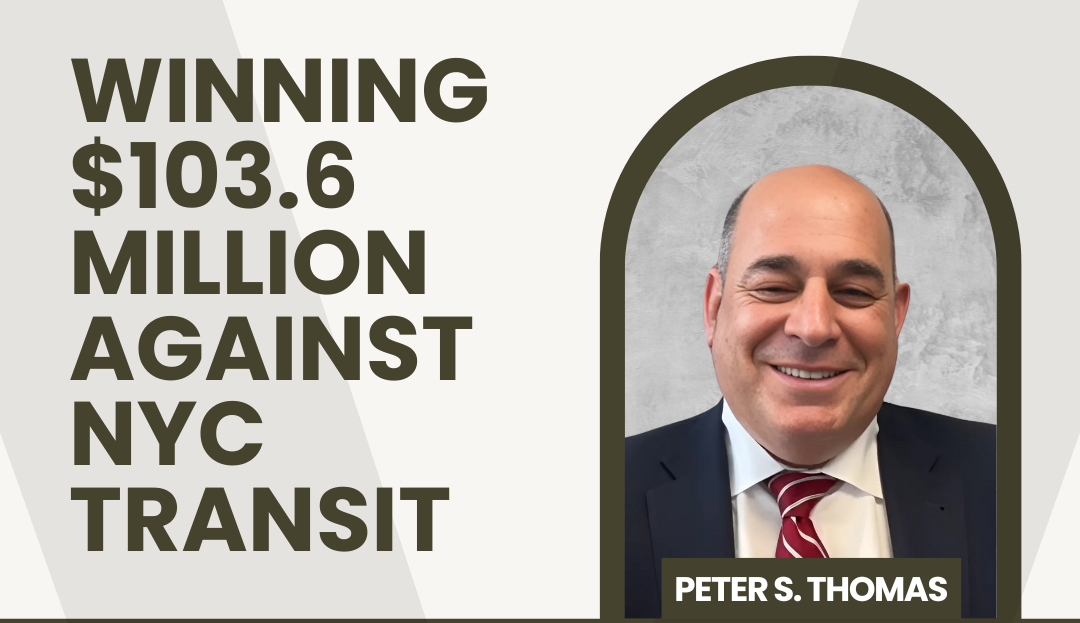
Welcome back to the Trial Bible podcast. We’re closing arguments echo louder than gavels. I’m your host Gennady Volz and today, boy, we’ve got a first class guest who just handed the New York City Transit Authority a multimillion dollar reality check. That’s right folks, joining us is the one, the only Peter S. Thomas, the Trial Titan who’s taken on
The train tightens and walked away with a verdict so big, even the MTA had to stop and check their Metro card balance. Peter, welcome to the show. How are you?
Peter S. Thomas (00:42.904)
Thank you, Gennady. ...
Gennady Voldz (00:04.245)
Welcome back to the Trial Bible podcast. We’re closing arguments echo louder than gavels. I’m your host Gennady Volz and today, boy, we’ve got a first class guest who just handed the New York City Transit Authority a multimillion dollar reality check. That’s right folks, joining us is the one, the only Peter S. Thomas, the Trial Titan who’s taken on
The train tightens and walked away with a verdict so big, even the MTA had to stop and check their Metro card balance. Peter, welcome to the show. How are you?
Peter S. Thomas (00:42.904)
Thank you, Gennady. Thank you for having me. I appreciate it.
Gennady Voldz (00:46.043)
It’s a pleasure to have you. We’ve heard the last name before Thomas. Our first guest was Dan Thomas. Any relation?
Peter S. Thomas (00:53.452)
My baby brother by 10 minutes, yeah, absolutely.
Gennady Voldz (00:56.535)
Dan Thomas was absolutely an excellent guest. Both of you come from a line of legal titans in the field. Your father was the great judge, Charles Thomas. And Judge, if you’re listening, you did good with these two boys. And we’re happy that you did everything that you could do to make them turn out the way they did.
How was it growing up in a family where your father is a judge, your brother is also in the business? Tell me a little bit about that.
Peter S. Thomas (01:33.28)
It was great. mean, it was every night at dinner, we would have conversations that were not just stimulating and exciting, but really helped to train us to think like lawyers and to problem solve and to think logically and approach situations a little differently than we were being taught, obviously, between our friends and school. So it was great. It was fantastic. I feel very fortunate.
Gennady Voldz (01:57.621)
You know, a lot of people think, do I go to law school? It’s a big ticket. It’s a big step financially to go through the process. And I’ve been telling everyone the beauty of law school is maybe not so much what you learn, but how they teach you to think and approach problems. I thought that was the biggest takeaway for me. It really made me think differently when I was talking to my friends and going about problems at work.
It completely changed the theory.
Peter S. Thomas (02:31.328)
Absolutely analytical thinking logical reasoning Taking I think it was Iraq our IR AC issue rule Analysis and conclusion and and that sort of and that’s how they taught us for legal writing But it’s also legal thinking you know if you can break down any issues into those four categories You pretty much can figure out where you’re going and how you want to proceed so
Yeah, my brother and I had been exposed to that at an early age without even knowing that we being exposed to it. Because my father would do more than just tell us about his cases. He’d ask us questions and how we thought and what we think he should say and what he should do and never really realizing that it was all just practice for our future.
Gennady Voldz (03:21.234)
Invaluable, those conversations are invaluable. Clearly they worked, both you and your brother, extremely successful trial attorneys. So I wanna set the stage here for this particular trial against New York City Transit. This wasn’t just any injury on the tracks. You have a train, you have two separate plaintiffs here and the Transit Authority trying to derail responsibility.
Tell us a little bit about the beginning details of what you got when you started this case as trial counsel.
Peter S. Thomas (03:54.83)
Well, first of all, there were two plaintiffs in this trial, Mr. Pedraza and Mr. Martinez. Mr. Pedraza’s case had already been tried once before by the attorney of record, and his name is Alan. And Alan had tried the case once before and got a verdict of $5 million from the jury, but
the jury found 60 % negligence against Mr. Pedraza for being on the subway tracks, more specifically at the Spring Street station, the number six downtown train. He was struck by a train at that station and sustained an amputation of his arm. And so being that the Transit Authority was denied an opportunity to claim qualified immunity as a defense,
and Alan thinking that a $5 million award was too little, they both appealed. And when they appealed, the court granted a new trial on all issues. But Alan had another case at the same station where we were alleging the same liability issues. And the court consolidated both actions, even though the second case, Martinez, his accident was three years later, three years after Pedraza.
They consolidated the cases for joint trial and based on the common issues on liability. So now I’m trying two cases with one jury, both sustained amputation injuries at the Spring Street station being hit by a number six downtown train. Mr. Martinez sustained a leg amputation, Mr. Martinez an arm amputation. So I’m given this case and I did something that I don’t usually do.
I didn’t even read the trial on the first case, Mr. no, sorry, Mr. Pedraza. I didn’t even read that trial transcript. I knew that they were expecting me to read the trial transcript and prepare for this case based on what has already been testified. I thought since I’m…
Gennady Voldz (06:02.1)
All right, go ahead.
Peter S. Thomas (06:05.27)
I thought since I’m coming in new, I want to take a new approach and I don’t want to repeat what was already said. Not only that, I was looking for a better verdict than had already been achieved in the first trial. So I figured if I start from scratch, I won’t be distracted, if you will, or I won’t be married in any way to any of the testimony in the prior case.
Gennady Voldz (06:26.132)
Let me see if I get this straight. You have two separate plaintiffs, Pedrazo and Martinez, both get hit, I’m sorry.
Peter S. Thomas (06:32.631)
draws up.
Pedraza with an A, not with an O.
Gennady Voldz (06:37.482)
So Rita, delete that, let’s start over. Let me see if I get this straight. We have two separate plaintiffs, Mr. Pedrazo and Mr. Martinez.
Peter S. Thomas (06:48.832)
Okay, if you’re gonna get it right, Pedraza. P-E-D-R-A-Z-A.
Gennady Voldz (06:51.68)
Pedraza, all right, had it spelled wrong. Rita deleted part two. All right, so let me see if I get this straight. You have two separate plaintiffs, Mr. Pedraza and Mr. Martinez. They’re both getting hit by the six train downtown at the Spring Street station. They both end up on the tracks of that station. Is there any other similarities between those two cases?
Peter S. Thomas (07:16.75)
Well, they both have elevated blood alcohol level in the hospital. So another way of saying is they were highly intoxicated.
Gennady Voldz (07:25.226)
Both highly intoxicated. What levels are we talking about here?
Peter S. Thomas (07:30.446)
Well, one had a 0.19 blood alcohol level, the other had a 0.21 blood alcohol level. And this was an hour or more after the accident.
Gennady Voldz (07:42.066)
And do these two guys know each other? All right, so just by… Go ahead.
Peter S. Thomas (07:44.45)
Not at all. only thing they have in common is they’re both Mexican and work in restaurants, and both working late nights and live in Brooklyn. So they were taking the six train back from their jobs in the city, back to their homes in Brooklyn, and somehow each of them ends up getting off at the Spring Street station, which is neither one of their stops, neither one of them.
had to or needed to get off at the Spring Street station but somehow found themselves getting off at the Spring Street station.
Gennady Voldz (08:20.618)
When you said that on appeal the transit authority wanted an immunity defense, what is that position that they wanted to take and thought that they would win on?
Peter S. Thomas (08:32.824)
but qualified immunity very much like when the police officers have protection from being sued if they’re doing their job if they they can’t be sued for manhandling somebody during the course of the rest this transit authorities claiming that they were entitled to the benefits of a qualified immunity you only get a qualified immunity as a municipality or quasi municipal agency like transit authority if you’ve done a study
And if you’ve done a study on the issue that is the issue before the jury, and if your study reveals that your, the basis for your decision and how you either in this case operate the trains, the speed at which the trains come into the station, if you’ve done a study and you can show a rational basis for the decisions you’ve made in light of that study,
then you could benefit from a qualified immunity and avoid responsibility because you’ve done this study. It’s very common in roadway design cases or when you have a situation where there’s an accident at an intersection, is there a need for traffic light? Is there a need for stop sign? If there are studies done that show that the rational basis for the decision was properly evaluated and analyzed and they continue to track it,
They can avoid responsibility even if it turns out it wasn’t the best decision.
Gennady Voldz (09:53.975)
All right, so let’s talk about strategy a little bit. You know going into this that we’re dealing with two drunk Mexicans after work on a track. Let’s just keep it very truthful with each other. That’s a tough fact to deal with in front of a jury. You know it, I know it, every trial lawyer knows it, every lawyer knows it when they’re picking up the case.
What do you do, whether it’s in jury selection, in opening, on direct with your client, what do you do to soften that up?
Peter S. Thomas (10:34.542)
There’s no way to soften it. You can only own it. And you can make sure that you don’t try and hide it and don’t try and run away from it. But the interesting issue in this case was that the New York City subway system is an open track system, which means there are no barriers. There are no doors. There are no separations between the platform and the tracks. Anybody can access the tracks.
And the Transit Authority knows that people who are incapacitated, people who are drunk, stoned, or stupid, I don’t know how else to describe it, use their system. Use the transit system. And their line of defense is to put a yellow line on the edge of the platform saying stand behind the yellow line and to make some announcements here and there. But nothing stops anybody from accessing the tracks. And people end up on the tracks for multiple reasons. People can be pushed.
People can jump down intentionally to get something that they’ve dropped. They could be trying to cross over to the other side. They could have a medical condition which caused them to lose their balance. They could be victims of crime and thrown on the tracks. There’s all kinds of reasons why people end up on the tracks. And the key here was that the Transit Authority knows it. And they’ve kept track of how many people actually end up on the tracks and are involved in what we call, what they call a 12-9.
That’s the code 12-9. That’s the code for somebody being struck by a train.
Gennady Voldz (12:03.56)
All right. Let me stop you Pete. I want to go back to, I pulled up the photo. This was one of the exhibits during your trial, right? And this is the Spring Street station. Is this showing where they were struck?
Peter S. Thomas (12:13.4)
correct.
Peter S. Thomas (12:21.976)
This is showing where Mr. Martinez was struck. Mr. Pedraza was struck closer to where that garbage can is in the photograph. So just about 30 feet away, 30 feet closer to the north end of the station where the train comes into the station was Mr. Pedraza. Mr. Martinez was about 30 feet down the track.
Gennady Voldz (12:29.654)
Yep.
Gennady Voldz (12:42.806)
So I wanna go back to my original question. How do you start to present to your jury pool or your jury that these two men were highly intoxicated and despite their intoxication levels, they were not at fault for this accident? What do you specifically do in this case?
Peter S. Thomas (13:03.916)
It starts in jury selection. And part of getting a jury that is going to be open to considering these claims is to bring that fact out, to tell the jury that my clients, both of them, on two separate occasions, they don’t know each other, were both struck by trains at the same station, and that when they arrived at the hospital, they both had elevated alcohol level.
and blood alcohol level, and then neither one of them is going to be able to tell you how they got there. If any of you feel that those facts alone are enough to cause you to render a decision before hearing the evidence, please let me know. And you, as you might believe, the majority of the room put their hands up and said, your client was on the track, shouldn’t be there.
Your client was intoxicated, what was he doing intoxicated on the tracks? The client got hit by a train and doesn’t know how he got hit? Yeah, no, I’ve already made up my mind. So by being as open and upfront with these facts in the very beginning, before I got even into the details as to how long the case was going to take, because a lot of times when you tell a jury pool this is going to be a five week trial, half the people say I don’t have five weeks to devote to this. So even before I got into the fact that it was going to be a five week trial,
I said I want to tell you some facts here which we’re not disputing and see if that affects any of your feelings or opinions about being a juror in the case.
Gennady Voldz (14:28.36)
Other than them being intoxicated, did you have any other particularly bad facts on this one that you wanted to put out there?
Peter S. Thomas (14:36.184)
Well, the fact that neither one of them knew how they got there. The testimony at the trial that was elicited was all the, both of them, they remember leaving work. And next thing you know, when they woke up, they were in the hospital with one less limb.
Gennady Voldz (14:51.008)
So there’s no dispute that the train hit these two individuals, right? What is the transit’s position with respect to defending liability?
Peter S. Thomas (14:55.822)
true. Correct.
Peter S. Thomas (15:04.737)
The Transit Authority took the position that they have an exclusive right of way on the tracks, that no one is allowed on the tracks. The only people on the tracks should be safety workers or contractors of the Transit Authority, and all that is planned in advance. Nobody belongs on the tracks. Nobody’s supposed to access the tracks. And if you’re on the tracks, you’re in violation of the rules.
Gennady Voldz (15:32.214)
You’re a trespasser.
Peter S. Thomas (15:34.252)
Your trespasser, exactly. That’s what they call it. They call them trespassers. So one of the things I did to try and also, I guess, soften that issue was the first thing I did when I walked in there, actually the very first thing I did when I walked into the jury room was I said to all the jurors, raise your hand. Everybody put your hand up. Everybody. And I looked at the defense attorneys. You too, put your hands up. Everybody puts their hands up.
And I said, leave your hand up only if you have never crossed the street against a red light. Leave your hand up only if you always wait for the traffic light to turn green before you cross the street. And I looked around the room and all the hands went down. Even the defense attorney’s hands went down. And I said, okay, now I know I’m talking to a room full of New Yorkers.
Gennady Voldz (16:03.702)
Okay.
Peter S. Thomas (16:33.644)
And I said to them, you have all broken the law. You all violated vehicle and traffic law by crossing the street against the red pedestrian signal. But what you’ve also did was you assessed your own risk. You knew that even though the light was red for you, you could cross without issue because there were no cars coming or whatever it is. Then I said to them, would you do the same thing if you were pushing a wheelchair?
or if you were holding the hand of your four-year-old nephew. Of course not, because now your assessment of risk is different. You’re now responsible for somebody else. So you’re not going to take those chances. Well, the New York City Transit Authority is responsible for everybody in their system. And this is a case about speed. And I said to them, and as we all learned probably in grade school, speed kills. Speed maims.
Speed can change people’s lives in an instant. And I made this case about speed. The speed of the train coming into the Spring Street station.
the downtown number six train in particular, because of the speed of that train, the configuration of this station, and the likelihood of somebody being on the tracks in that station, and the inability of a train operator to see if there’s anybody or anything on the tracks coming into that station became the theme of my case.
Gennady Voldz (18:00.055)
So really you brought up a pretty new theory of liability against the New York City Transit Authority that I don’t know if anyone has brought up this particular, this specific type of case saying you guys are pulling into the station too quickly, specifically the Spring Street station.
Peter S. Thomas (18:22.754)
That’s right. And we were able to take this information that we got from the Transit Authority, specifically a document called a struck list. And a struck list is kept because every time somebody pulls the emergency brake or the emergency brake is engaged, the central command has to be notified. And when there are situations where the train operator is the one who hits the emergency brake because there’s someone on the tracks or something on the tracks,
And if there is a person on the track and the train hits the person, it’s called a 12-9, 12-9, that’s the code. And they keep track of all these 12-9s. And we were able to get this struck list from 1987 through 2006. And actually, sorry, I’m sorry, yeah, we were able to get this struck list from 1987 through 2016. And when we looked at the struck list, we found statistically,
Gennady Voldz (19:04.054)
2016, I believe, right?
Peter S. Thomas (19:16.482)
that the Spring Street station, specifically the number six train at Spring Street, had a five to nine time higher rate of incidents of people being struck by trains, depending on which 10 year period you’re looking at. But still, an elevated percentage of people struck by trains at this station. And one of the things we came up with was that as the southbound or downtown number six train pulls into that station,
It’s a big deep curve that the train operator is blind, has a very, very limited sight into the station until he gets into the station. So at a speed of 27 to 30 miles an hour, if there’s somebody on the tracks, there’s no way that train is gonna be able to stop. Most other stations in the system are straight tracks. So you can see down the track into the station even before the train gets into the station, not at this station.
Gennady Voldz (20:12.352)
Did you have any kind of exhibit showing the jury what the station looked like?
Peter S. Thomas (20:18.604)
Yes, in the course of discovery, we were able to get lots of documents, including architectural drawings. And one thing we got was the Spring Street Station site plan, or the platform station plan. And that was drafted, I believe, in 1987. And we took that document and we blew it up. We blew it up very large. We needed multiple easels to keep, yeah, there it is. We needed multiple easels to keep it level so the jury could see it.
And this is the Spring Street station plan that shows the southbound number six train coming into the station. And the thing that we argued was if you see the entrance to the platform is at the northern portion of the station. So when people come into the station, that’s the north end, that arrow that says north end of station, that’s the very start of where
the train comes into the station. But if you look a little to the left, you see the platform entrance. Yeah, right there. That platform entrance. There’s only one entrance to this platform. And it’s at the northernmost part of the station. So when you have somebody who’s impaired by drugs or alcohol or maybe prescription medications, whatever it may be, they’re asked to come into that station and stand in an area where the train comes in the fastest.
Gennady Voldz (21:22.996)
Right.
Peter S. Thomas (21:46.348)
The safest part of that station would be the further end, the other end of the station, the south end of the station, where the train would be coming in at its slowest rate of speed. So the other thing is, if you get off at that station, you have to go out and pay again to get back in. There’s no way to get to the other side without having to pay the fare again. So what we found was that at this particular station, people would cross the tracks to get to the other side.
So they didn’t have to pay to get back into the train system.
Gennady Voldz (22:19.072)
So to get back to your theory of liability challenging their speed, their speed policy, what kind of defense did they put on? What kind of witnesses did they put on to try and defend that this was a perfectly normal speed for the train to go and this is just how things are done?
Peter S. Thomas (22:26.126)
speed policy. Correct.
Peter S. Thomas (22:43.116)
They put on train operators. They put on rail safety people. They put on the chief of planning and operations. They put on expert witnesses. And the theme of all these witnesses that were testifying for the defendants were, we are a rapid transit system. We have to find ways to make the trains run faster while still being safe. We cannot slow the trains down.
Gennady Voldz (23:10.982)
anything pop out, anything happen during your cross, I’ve seen you in action. I know that cross examination is a lot of fun for us trial guys. It’s where a lot of the fireworks start to happen. And, you know, I even tell the jury sometimes in jury selection, you okay with me ruffling a few feathers if it means getting down to the truth? Are you okay with that? No one’s going to hold that against me.
I know you do that as well. I know you like to have a lot of fun in your cross. So did anything happen during cross examination of their witnesses that kind of tilted the tide?
Peter S. Thomas (23:52.918)
Yes, well there were two witnesses in particular who I think really not only were being honest but couldn’t defend with the type of questions that I was asking and the information they revealed turned out to be shocking. The jury was shocked. The jury was in fact mad. There’s no other way to describe it. They were angry when they heard the testimony of these two witnesses on these two issues.
First I’ll tell you there was the train operator. And the train operator was testifying about how many different stations there are in the transit system that have curved stations, the tracks curve when they come into the station, and that there’s no issues and things like that. And I said to him, the recommendation by the plaintiff’s expert was that the train be slowed down to 15 miles an hour before it enters the station.
so that in the event somebody is on the tracks, the train can stop in time to avoid hitting them. And I said to him, is there a speed limit sign in the tunnel that would restrict the train coming into that station to reduce speed? He said, no, there is not. I said, would you agree that there should be one? And he did not want to answer that question.
He said, it’s above my pay grade that no one’s ever asked me. It’s not my job. And then I asked him sort of a hypothetical. Let’s say that somebody in upper management said to you, Mr. Train Operator, yes or no? Should we put a speed limit sign reducing the speed of the train coming into the station to 15 miles an hour instead of the 30 miles an hour that the train comes into right now? What would you say? And he said,
I would probably say yes, we should put a speed limit sign there. So that was an aha moment, but there was another aha moment that I think was even bigger than that.
Gennady Voldz (25:57.121)
Hold on, I just wanna highlight the art of the question, the art of the answer that you’re gonna get. You’re setting up a question where either he’s gonna agree with you or what’s the alternative? He’s gonna look like an asshole and say, absolutely not, I don’t think so, I don’t care about the safety of what happens on my tracks. You’re setting him up with an impossible question.
Peter S. Thomas (26:25.282)
Well, we know what the proper answer should be from a safety point of view. But when you are less concerned about safety and more concerned about meeting your time schedule, then you’re going to give the answer that he gave. I knew that no matter how he answered the question, I would be able to come back with the facts of this case and ask him how he reconciles his response in light of these facts.
Gennady Voldz (26:38.409)
I love it.
Gennady Voldz (26:51.946)
That’s called trial art, folks. If you can come up with questions on Cross where you cannot lose, you’re off to a great verdict. All right, so what was the second one?
Peter S. Thomas (27:05.71)
Okay, so the second one was their chief of planning and operations. This was a guy who was actually involved in making policy for the Transit Authority in terms of regulating speed or not regulating speed of the trains coming into stations. And I do want to tell you that there are certain stations that the trains are regulated in terms of speed. For example, the 42nd Street station has a speed limit. There are other trains, other, uh, uh,
stations throughout the system that have regulated speeds for multiple reasons. But this question that I asked of their chief of planning and operations.
I said, sir, would you agree to slow the train down by three miles an hour coming into the Spring Street station if it would save a life or a limb? And he said, no. I said, sir, would you slow the train down by two miles an hour? The number six train downtown coming into Spring Street station.
by two miles an hour if it would save a life or a limb. He said no. And of course, when I said, sir, would you slow the number six train down by one mile an hour coming into the Spring Street station if it would save a life or a limb? And he said, no, we are a rapid transit system. We don’t slow the trains down.
Based on that answer, the jury was visibly moving around in their chairs. The jury was folding their arms, shaking their heads. I even heard one or two jurors sucking their teeth. Like, couldn’t believe what he just said. So the way the question was asked was really important. And the fact that it was asked the rule of threes. I could have just said,
Peter S. Thomas (29:09.646)
You know, would you slow the train down by one, two, three miles an hour if it would save a life or a limb? I don’t think it would have had the same effect. But by breaking down that question into three parts, with three miles, two miles, one mile, really brought the point home. And the jury was visibly upset.
Gennady Voldz (29:29.152)
So he really put, they really put all their eggs in one speed basket and they said, we won’t slow down the train. We have passengers to deliver from point A to point B and our priority is moving those passengers first and then safety second.
Peter S. Thomas (29:49.038)
And I went one step further and I said, well, if you slow the train down, that might mean less revenue for you. And he tried to sort of shake that off and say, it’s not about revenue. We have to be reliable system that moves people safely. I said, but isn’t it about money? Aren’t you still a business? Aren’t you trying to make money? And of course he said, it’s not about the money. Now what they did was we asked.
Gennady Voldz (30:15.73)
It’s always about the money. It’s always about the money. All these cases that we talk about, it’s someone focusing more on money than on the public’s safety. it’s just set. Go ahead.
Peter S. Thomas (30:19.298)
That’s right.
Peter S. Thomas (30:31.17)
But let me tell you what they did that really, I think, was not very smart on that part. We asked that they slow the train down at one station, the Spring Street station.
They took that request and they went and said, well, if we slow the train down at Spring Street, we have to slow it down at every station. And then they did an analysis for how much of a delay it would cause in the course of a day by slowing down each train coming into every station. And they said, because we can’t do that, we’re not going to slow the train down at any station. So again, it’s their own, I’ll call it stupidity. I’ll call it nonsense.
We asked that you focus on one station and they heard that and said, we have to do it at every station or we don’t do it at any stations. Nobody asked you to slow the trains down at every single station. There are plenty of stations in the system that have a long straightaway that the train operator can see into the station and be able to engage the brake long enough to be able to stop before entering the station, let alone hitting somebody that’s on the tracks. But there’s only 12 stations in the entire system.
that are seriously restricted because of the curvature of the station and the curvature of the tracks coming into the station. 12 out of 492 stations, only 12. Would it have been so difficult for them to focus on those 12? That’s not what they did.
Gennady Voldz (31:56.161)
So relating it back to the PJI charges that were applicable on this case, which is two colon 161, common carrier duty to a passenger and two colon 176, duty to the public persons on or near tracks. Both of those PJI charges have a reasonably foreseen language in there. Other than the struck list,
Was there anything else that gave notice to the New York City Transit system that this was happening and that they should have made change a long time ago?
Peter S. Thomas (32:36.418)
Well, we called a statistician. We had a statistics expert come in and analyze the information. And he was able to tell the jury that on average, two to three people a week are struck by trains within the system. And if that’s not notice, then I don’t know what is. Their own struck list was the notice that we used to show that they were very well aware for all kinds of reasons that people end up on the tracks.
and we excluded, we intentionally excluded suicides. Now not every single train strike can be determined as a suicide, but those that clearly were because they either told somebody they were gonna do it or left a note or something like that, we excluded those numbers from our statistics.
Gennady Voldz (33:23.318)
Tell our listeners a little bit about the New York City bill and assembly that was tried to be passed in February of 2011.
Peter S. Thomas (33:33.772)
right, the Crespo bill. There was a bill that was introduced that required, that would have required the trains to stop before entering the station, to not just protect people on the tracks, but also to protect the workers, the transit workers. Remember, both train operators in this case were out of work for one for a year and one for many months seeking psychological and emotional counseling.
for their experience involved in these accidents. And it also slows down the train by hours. We were asking that they slow the train down to 15 miles an hour, which would have been 9.8 seconds longer than the train would have taken to come into that station if it didn’t slow down. When you hit someone, train is out of service for an hour or two or more.
So realistically, when you think about it, asking them to slow the train down to add 9.8 seconds to that stop is not really unreasonable. But when you hit somebody and the train is out for two or three hours, that’s going to cause definitely a backlog in ability to get people where they’re going.
Gennady Voldz (34:49.664)
Talk to me about your strategy when it came to the qualified immunity defense. How did you start to prepare the jury for that and how did you work it throughout the trial?
Peter S. Thomas (35:03.202)
Well, since I knew they did not do a formal study of this issue, the only study they did was how fast can they operate the trains and how fast can they operate the trains without derailing the train and how fast can they operate the train without throwing people out of their seats. And they labeled it two different things. They said there’s the comfort speed and there’s a safety speed. The comfort speed, the speed the trains can go where people could still be comfortable.
The safety speed was the speed that you can operate the train without affecting the equipment. know, derailing the train or having the train hit the platform edge as it comes in. So those are the two speeds that they considered. They never considered slowing down the train at certain stations because of limited sight line of the train operator. So since I knew they never did that study, I pointed out to their experts and their witnesses, where is the study that you did?
that considered this issue. And they said, well, we did a train simulation. I said, what do you mean? They said, we used a computer program called RailSim, R-A-I-L-Sim. RailSim, and we put information in there and the RailSim program told us that we could continue to operate the trains at maximum attainable speeds. So they didn’t do a study, they did a computer.
program analysis and that was it. And I made a big deal about a study means you start with a hypothesis, you do research, you do testing, and you either prove or disprove your hypothesis. That’s a study. Did you do that? And they said, no. We did a rail simulation. They never used actual trains. They never did it during the, at night or even off site.
where they have testing in Connecticut. They have a simulated train car that’s about a mile and a half long. They never did any reconstruction or any attempt to use real trains and real stations to do their analysis. They just use a computer program, and that simply is not enough.
Gennady Voldz (37:20.631)
So you made a big distinction between what it is that they claim to their study was, in fact, was not specific enough to be deemed a real study when it came to the Spring Street station and the speed of this six train coming in on the northbound side.
Peter S. Thomas (37:29.816)
Mm-mm.
Peter S. Thomas (37:41.176)
Correct. had to prove that they one, did a study. Two, they did a study of the issue that’s before the jury. Three, that the decisions they made based on that study were rational. And four, that they continued to monitor it to see if there were any changes that needed to be made.
Since they never did a bona fide study, it didn’t matter how many computer simulations they did, how much analysis they did, how much number crunching they did, they never did a study. And since they never did a study, they were never going to be entitled to qualified immunity.
Gennady Voldz (38:13.313)
Did the trial judge allow the qualified immunity defense on the verdict sheet for them?
Peter S. Thomas (38:20.206)
Yes, he did. He gave questions on the verdict sheet to the jury to ask the jury whether in fact they did a study, whether that study was there was a rational basis for the decisions they made. He asked all those relevant questions on the verdict sheet. The verdict sheet was I think 25 pages.
Gennady Voldz (38:37.079)
So when it came to, this is New York County, New York County is bifurcated, the jury’s hearing both liability and damages at the same time. When it came to the liability verdict, you had mentioned in the beginning of this show that Mr. Pedraza’s case previously had a 40 % liability verdict against Mr. Pedraza, 60 % against the.
Peter S. Thomas (39:00.878)
No, 60 % against Mr. Pedrazo.
Gennady Voldz (39:04.747)
Let me redo that, Reeder, let me redo it. Let’s talk about the liability portion here. You had mentioned earlier in the show that the original trial that happened about five years prior to this, that the jury found Mr. Pedraza 60 % at fault for his own accident, correct? After Mr. Thomas steps into the courtroom and does his razzle dazzle and tells these jurors,
Peter S. Thomas (39:24.76)
That’s correct.
Gennady Voldz (39:34.613)
what they need to hear, what was the liability against the New York City transit system.
Peter S. Thomas (39:42.19)
Well, in this case, there were three entities on the verdict sheet. It was the Transit Authority, it was the train operator, and then each plaintiff. The jury found no negligence, no responsibility against either of the train operators, no negligence, no responsibility against either of the plaintiffs, and found the Transit Authority 100 % responsible in both cases based on their failing to appreciate that speed at which the train comes into the station
is just too great for a train operator to be able to stop before hitting somebody who’s on the tracks.
Gennady Voldz (40:17.899)
Give us a little bit of the closing arguments on liability. Why being intoxicated, having no idea how this happened, where they were at the time, why it’s not their fault.
Peter S. Thomas (40:34.52)
You know, I was expecting and anticipating an argument from the defense that would have connected the alcohol consumption to their being on the tracks. And they called a medical toxicologist to testify. And their medical toxicologist took the alcohol levels at the hospital, extrapolated back to the time of the accident to testify and render an opinion that at the time of the accident, both of them had
I think one I think had a must have had nine drinks and the other had seven drinks to have a blood alcohol content of what was listed in the hospital report. And on cross examination, I said to that expert, okay, we can see they both had elevated blood alcohol levels in the hospital. How does that put them on the tracks? She goes, I don’t know. I said, how does the elevated blood alcohol level support the position
that they’re responsible for being on the tracks themselves. She goes, it doesn’t. So their own expert was not able to connect the alcohol use and their being on the track, especially when I said to her, are you aware that either one of them may have been victim of a crime and pushed on the tracks? May have misstepped that had nothing to do with alcohol? May have just fallen asleep and rolled onto the track? I mean, there’s all different types of reasons. And their expert said, yes, any of those things is possible. That’s not my job here is to make that determination.
So the one witness that they were relying on to try and causally connect the alcohol consumption to their position on the tracks was not able to do that based on the limited information that she was given. So I argued to the jury, the defendants have not met their burden of proving that the plaintiffs were negligent. We don’t deny they increased levels of alcohol. But are you supposed to take the train if you’re intoxicated? Better than getting behind the wheel of a car and driving.
And how often does the New York City subway system know that people who take the trains are impaired, either by drugs, alcohol, prescription medications, failing to take their prescription medications? And then I mentioned, what happens on New Year’s Eve? Aren’t the subways packed with people going in and out of the city to celebrate? And how many of them do you think are intoxicated, above the legal limit to be able to drive? And she said, I’m sure many, many of them.
Peter S. Thomas (43:01.656)
So the Transit Authority knows that people who use their subway could be intoxicated, have elevated blood alcohol levels? yes, absolutely. So it was two parts. There were two parts of that testimony. One, she couldn’t causally relate. And two, the Transit Authority very well knows that the people that use their system are intoxicated. She then said, you’re not allowed to drink in the subway. Okay, what if you drank before you got into the subway? She says, yeah, you can’t stop that.
They know about it. So once again, those facts were not properly addressed by the defense to show to the jury that either one of these plaintiffs was responsible themselves for ending up on the tracks. They didn’t know how they got there. So I argued in my summation, the defense has failed to meet their burden of showing you facts in this case that the plaintiffs themselves were responsible. And the jury agreed.
Gennady Voldz (44:00.903)
I had the pleasure of sitting in on the closings for both you and the New York City Transit System and
You know, I’m always surprised that defendants who dig their heels in to a position that sounds ludicrous to me. The fact that they continue to emphasize that our ethos in this case is to move as quickly, move passengers as quickly and safely as possible. He kept saying it in that order, quickly and safely. And you know, just the position of those words.
is so powerful rather than saying safely and quickly when you’re defending a case. Some of the parts that you started saying were just so powerful. I’m just going to mention a few because I took notes as you were giving your closing statement. You said,
Well, I love it when you refer back to some of the some of the stuff that the defense counsel does when when they were giving their closing, they had this PowerPoint and he was trying to be all fancy with technology. You got up there and said, I don’t have a PowerPoint, but I have the facts and the law. And the truth is here, the New York City Transit Authority has zero value for human life. So powerful.
for a jury to hear that. You said they’re not giving you reasons, they’re giving excuses. And when it comes down to it, I’m gonna quote you here, if you’re on the track, there’s a chance you won’t make it.
Peter S. Thomas (45:46.062)
That’s right.
Gennady Voldz (45:47.617)
hearing that as a New Yorker who’s taken the subway system, let alone the disaster that the subway system has become post COVID, knowing how dangerous of a place this subway system is, and knowing that people fall in, people get pushed in, people drop their belongings on these tracks, to say it in those words, if you’re on the track, there’s a chance you won’t make it, was the crux of this case.
And it was really the transit authority standing there and saying, yeah, we know that. And our job is to move people quickly. too bad. Congratulations on the liability verdict. I want to get to damages. You knew before you went into this that you were going to be asking for a large number because of the injury itself. Tell us again, what were the injuries to Mr. Pedraza and Mr. Martinez?
Peter S. Thomas (46:46.69)
Mr. Bedraza was a 46 year old restaurant worker and he lost his left arm. And Mr. Martinez was a 23 year old restaurant worker and he lost his leg. Below the knee.
Gennady Voldz (46:58.775)
So hold on, both of them lost the limb. Sounds tragic, sounds significant, but again, I’m sitting in this courtroom and I’m looking at these two guys. They looked good, to be honest with you. They were cleaned up, they were wearing suits. They didn’t look like they were hobbling around or anything like that. They looked like two normal guys walking around New York City.
Peter S. Thomas (47:03.182)
Correct.
Gennady Voldz (47:26.859)
How did you get the jury to?
empathize with their pain and suffering that they’ve been through as a result of this.
Peter S. Thomas (47:38.626)
Well, first I showed the jury photographs of both Mr. Bedraza and Mr. Martinez as to what they look like with their missing limbs. And then while they were on the witness stand, I asked Mr. Bedraza, can we see your shoulder, where your arm used to be? And we watched him disrobe, unbutton his shirt, pull his shirt to the side, and he showed the the site where his arm was amputated at the shoulder.
for Mr. Martinez, he took his pants down and of course I prepared him in advance so he wasn’t, you know, gonna embarrass himself but he was wearing shorts under his pants and he took his pants down and he took off his prosthetic leg and he showed the jury his prosthesis that was wrapped in black electrical tape and gray duct tape. I said, why do you have the tape there? He says, because it’s eight years old and it’s cracked.
and it doesn’t fit right and I don’t have the money to buy a new one. So here this eight-year-old prosthetic limb is being held together with electrical tape and duct tape and the jury’s impression was how can this be? How can this guy even, you know, live a normal life when he doesn’t can’t even afford a new prosthesis, a well-fitting prosthesis? And the testimony from our experts was that he’s going to need a new prosthesis every three to four years.
That’s how much wear and tear it gets. And here it is now eight years post-accident and he’s still with the same prosthesis. It was very powerful. The jury watching them navigate, just even getting dressed and getting undressed was very, very powerful from the witness stand.
better than any day in the life video, better than any blow up photographs that I can show them. They were watching them in real time, how they operate and how they get along.
Gennady Voldz (49:37.141)
You’re no rookie to asking for a lot of money. And I know you make it a point to tell the jury as quickly as you can. I’m going to be asking for a lot of money. Give us a little bit of the gems, if you will, on how you go about doing that, conditioning this jury to understand that the only right verdict here is a large one. How do you do that?
Peter S. Thomas (50:06.744)
Well, in this case, because the Transit Authority really didn’t have much of a defense, I was able to use the fact that you have two plaintiffs with missing limbs. This isn’t just a sprained ankle case. They’re going to have lifelong disabilities. They have limitations and restrictions in everyday activities for the rest of their lives.
but it was also about letting the Transit Authority know that you don’t appreciate the strategy that they’ve employed. And this stick your head in the sand type approach of, you shouldn’t have been there and you wouldn’t have gotten a hit. It was a way of getting the jury not just to consider what fair and adequate compensation would be for the injuries proven and for the damages proven, but also to let the Transit Authority know this has to change. Something has to be done.
and I tried to balance both of those issues but primarily you have Mr. Pedraza 13 years since the accident without his arm and another 22.2 years on his life expectancy.
Mr. Martinez nine years without his leg since the accident and another 46.7 years on his life expectancy. So I was able to use the future life expectancy as a way of letting the jury know that’s where the big money is, is in their futures.
Gennady Voldz (51:30.219)
When do you start talking about money to the jury?
Peter S. Thomas (51:33.966)
jury selection right away. tell them the only thing the court allows in terms of compensation is money. I’m not apologizing for it. I’m letting you know right now that at the end of this case, all you can do is award a sum of money that will fairly and adequately compensate the plaintiffs for all damages. And our job here, my job here is to make sure that my clients do not get shortchanged. No discounts.
pain and suffering is not on sale. So even if you do find split liability, meaning the plaintiffs are partially responsible and the defendants are partially responsible, we are still entitled to know what 100 % compensation would be for the damages proven. Don’t do the math yourself.
Gennady Voldz (52:19.445)
What was the pretrial offer on this case?
Peter S. Thomas (52:24.354)
zero.
Gennady Voldz (52:28.011)
The verdict, how much was it?
Peter S. Thomas (52:33.39)
The total verdict for both plaintiffs came out to $103.6 million. The jury awarded 20, as I told them in my summation, Mr. Pedraza has been 13 years since the accident. They awarded $20 million for past pain and suffering.
and they gave him $25 million for future pain and suffering. So Mr. Pedraza, who only had a pain and suffering claim, got $45 million. Mr. Martinez, they gave him $10 million for past pain and suffering, and they gave him $47 million for future pain and suffering. And then they gave him another $3.5 million for…
future medicals, including new prosthesis and diagnostic testing and follow-up visits for therapy. So the total came out to $103.6 million between the both of them.
Gennady Voldz (53:33.459)
If we took $103.6 million in singles, how many train cars do you think we’d have to fill up? That’s not a verdict. That’s a train load of justice. Talk to me about the experts for damages. What kind of experts did you use to bolster your damages claim?
Peter S. Thomas (53:47.522)
Yes.
Peter S. Thomas (53:55.778)
Well, we had a prostitutes, somebody who understands the value and the need for prosthetic devices. We had a life care planner who was a medical doctor. We had a economist who was able to take the life care planners projected figures and put a chart together for the jury as to what with inflation, what it would be over time. We had a orthopedic surgeon who talked about the surgical procedures.
And what was very interesting about this case is, again, one guy lost his arm at the shoulder, one guy lost his leg just below the knee, but there was not a lot of blood. And there was not a lot of, you know, you would think there’d be carnage on the tracks. The hot train wheel against the hot rail.
helps to cauterize the wound, even though the train ran over their limbs and cut off their limbs. Because it’s so hot, it actually helped to cauterize the wound and prevented a loss of blood. Mr. Martinez was under the train for about 40 minutes before they were able to extract him. In the usual situation, you lose your leg, you could bleed out and not make it. But by virtue of the heat from the rails that they were on, helped to cauterize the wound and limit the loss of blood.
Gennady Voldz (55:15.735)
How long was this trial?
Peter S. Thomas (55:18.136)
The trial was five weeks.
Gennady Voldz (55:20.513)
How do you stay sane? How do you stay with it? How do you stay on top of the next day when you’re going five weeks? What do you do?
Peter S. Thomas (55:29.28)
It’s just one witness at a time, really. I don’t prepare for the last witness first. I try and anticipate, you know, I know who my witnesses are going to be and I ask defense counsel who you’re to call tomorrow, who you’re to call the next day to try and get an idea as to who’s going to be called. So, for example, on their last witness, I didn’t even start to prepare for that last witness until I was about three and half weeks into the trial.
Gennady Voldz (55:54.101)
Is there something that you do, walk us into your personal life a little bit if I may. Is there something that you do either just before trial or even during the trial to kind of recenter yourself, to find that peace within the storm that helps you realign of how you’re gonna present this case?
Peter S. Thomas (56:17.602)
Well, what I can tell you is most trial lawyers are just frustrated actors or musicians or entertainers. And I guess I fall into that category as well. I play guitar.
And when I come home after a stressful day or when I’m done getting ready, I’ll pick up my guitar and just play a few songs just to decompress, just to get back to sort of center. And it works very well for me. I don’t have any quirky sort of yoga tips or meditations that I do. I just like to play a little guitar and that helps me to reboot and you know.
Go to the next thing. Listen, I make more money as a lawyer than I do as a singer, so.
Gennady Voldz (56:59.863)
You brought up music, so I’m gonna ask you this one. You’re up at bat, you’re coming into the courtroom hot, what’s your walkout song?
Peter S. Thomas (57:10.542)
You know the song that keeps playing in my head is Eye of the Tiger. know, Rocky’s Eye of the Tiger. Maybe I’m a victim of my own upbringing, but that to me was like the triumph song. That was the song. That’s like the underdog. That’s like the when you hear that you know that somebody just beat the odds. So Eye of the Tiger.
Gennady Voldz (57:30.487)
You’re playing that after the verdict or as you’re walking in on day one.
Peter S. Thomas (57:35.522)
day one in the middle of the trial and of course at the end of the case. Yeah, that’s the recurring song playing in my head.
Gennady Voldz (57:43.123)
I love that. All right. This wasn’t just a verdict. This sent a message to our transit system and it did so in a big, big, big way. You did something I believe here that will not go unnoticed and
You’ve already established change within the transit systems culture. You started to get a few pictures after the verdict. Tell us what those pictures were of.
Peter S. Thomas (58:23.242)
Actually, one of them was from a juror on the case who said, guess we’re starting to make a difference. And it’s a picture, it wasn’t at the Spring Street station, it was another station, I believe it was the Fulton Street station. And they put up these gates. They’re small little sort of waist high type gates that are on the platform.
that are meant to prevent somebody from accessing the platform. When the train pulls into the station, there are no doors at that location. That’s right, you have it up right now. And these gates may help to deflect somebody from falling onto the tracks or prevent somebody from being pushed onto the tracks. It doesn’t take a lot. And had this been in place at the time of both Mr. Martinez and Mr. Pedraza’s accident, there’s a very good chance that neither one of them would have ended up on the tracks.
Gennady Voldz (59:16.705)
So you see them here folks, I’m putting up a photo of it. I think this is the photo that came from the jurors, is that right Pete? If you live in New York and you take the subway system and you start to see these gates, I want you to thank Peter Thomas because he’s the guy that was the courtroom conductor, the justice engineer.
Peter S. Thomas (59:23.266)
I believe so, yes.
Gennady Voldz (59:44.353)
Today’s featured verdict slayer that really made a difference for New Yorkers with this verdict, not just for Mr. Pedraza, Mr. Martinez, but everyone that rides the New York City transit system. Peter, I wanna thank you personally for coming onto the show. Thank you for the trial justice that you continue to deliver case after case.
It’s a pleasure having you as a friend, as a mentor. Always a pleasure speaking with you.
Peter S. Thomas (01:00:18.36)
Thank you very much for having me. Yeah, this is just one of the many cases that I’ve been involved in over the years. And I’m very proud of the outcome. I’m proud of the justice that we were able to get for both of the plaintiffs. And I’m glad to see that the Transit Authority is actually paying attention. I mean, does it take a hundred million dollar verdict for them to start considering safety? I guess the answer to that question is yes, because within a week of the verdict, these gates started going up. And…
I hope that this is just the beginning of more safety gates or other safety mechanisms that they can put in place to truly avoid something that they know happens on a regular basis. People access the tracks for all kinds of reasons. This may help to prevent them from actually ending up on the tracks.
Gennady Voldz (01:01:08.179)
Excellent job, Pete. Folks, thanks for riding with us on Trial Bible. Remember, when the other side brings a train, you bring the truth with torque. We’ll see you guys on the next one.
In this riveting installment of Trial Bible, host Gennady Voldz welcomes veteran trial lawyer Daniel A. Thomas for an in-depth look at the $287 million verdict that shook Harley-Davidson to its core. What began as a carefree ride on a Harley Tri Glide trike spiraled into a heartbreaking tragedy — and ultimately, a courtroom showdown that exposed a disturbing pattern of corporate misconduct, concealed evidence, and an orchestrated effort to suppress the truth.
Daniel recounts how he and co-counsel Paul Edelstein dismantled Harley’s claim that the defect was “impossible,” unearthed over 90 previously undisclosed complaints, and convinced a jury to return one of the most powerful and emotionally charged product liability verdicts in recent memory.

[00:00:00]
[00:00:32] Gennady Voldz: All right. Welcome back to the Trial Bible where we peel back the legal curtain, one verdict at a time.
[00:00:39] Gennady Voldz: I’m your host Gennady, and today we’re riding into some seriously bumpy territory. Buckle your helmets, folks, because we’re talking about a Harley Davidson trike that went from Freedom Machine to legal nightmare. Joining me is. One of ...
[00:00:00]
[00:00:32] Gennady Voldz: All right. Welcome back to the Trial Bible where we peel back the legal curtain, one verdict at a time.
[00:00:39] Gennady Voldz: I’m your host Gennady, and today we’re riding into some seriously bumpy territory. Buckle your helmets, folks, because we’re talking about a Harley Davidson trike that went from Freedom Machine to legal nightmare. Joining me is. One of the most incredible trial attorneys I know who took this defective trike case all the way to the finish line and left the jury roaring louder than a V twin.
[00:01:08] Gennady Voldz: Please welcome the man who [revved up the courtroom, Daniel A. Thomas. Daniel, how are you doing today?
[00:01:16] Daniel Thomas: I’m good, Gennady. How are you? Thanks for that intro. I could safely say that I’ve never been introduced like that, ever.
[00:01:23] Gennady Voldz: Pretty on, pretty on point.
[00:01:24] Daniel Thomas: It’s very kind.
[00:01:25] Gennady Voldz: So let’s jump right into it. Give us the, uh. Opening throttle here. What happened in this Harley Davidson trike case? What, what, what are the details, uh, that you started off with in the beginning of this case?
[00:01:41] Daniel Thomas: Okay. the most important detail is that Harley Davidson decided in order to keep its older aging ridership, it was going to go forward with a trike, a three wheel trike, which is essentially one wheel in the front, two in the back, and put it — load up with all kinds of bells and whistles, including things that actually were counterintuitive to the actual safe operation of the machine, including a feature called traction control. So they put all these bells and whistles in terms of assist and warning signs and lights would go on and all that stuff, but they didn’t really think it out well, and they rushed the production.
[00:02:16] Daniel Thomas: They had combined their resources and they retained the services of a Bosch engineering group, to build some of the software features, including the traction control. You had a scenario in which, the client (Harold), he and his girlfriend Pam (long time Harley riders) — she was getting a little skittish from having been on these two wheelers and as they getting older with balance issues.
[00:02:37] Daniel Thomas: So they decided they were gonna trade in the two wheeler for the three wheeler and get this 2019 Harley Tri Glide trike. Bought a brand new, and, ultimately things were going fine. But, about a thousand miles in change, about 1,050, 1,060 miles in change; they’re in Florida with the trike and the thing just suddenly veers off to the left, across two lanes of traffic over grassy knoll and then ultimately crashes into bushes. They get hurt but not severely, and bike gets pretty banged up. He sends it back to where they came from in Rochester, New York and had it repaired and, just didn’t know what happened. He just couldn’t figure it out.[
[00:03:20] Daniel Thomas: Then fast forward to — so that was February of 2019. So fast forward to November of 2019. Harley puts out a recall notice saying we have a defect on the bike and bring it into your dealer and have a software patch put on. And Harold says, you know, wow, that sounds like what happened to me. He contacts Harley. Harley’s like, well, we looked into it, we investigated, and sorry, it’s not the defect. You’re going too fast. The defect only happens under 40.5 miles an hour. So too bad, so sad. Sorry. Can’t help you. Go with your insurance. It’s not a warranty issue, it’s on, you could be operator error, but you know — don’t look to us.
[00:03:56] Daniel Thomas: So he sort of accepts that because it’s all very formal. It gets a letter and a whole deal. And then, fast forward to June of –actually today is the anniversary, the five year anniversary — June 6th, 2020. They’re in Pennsylvania and the tri, again, after it was repaired and the software patch was put on it, suddenly goes off the road. And this time it goes up in embankment, and Pam was ejected (the passenger), and she sadly died as a result of being ejected and her injuries. And Harold was severely injured, youknow, he is in a coma and they gave him last rights like four times in the first two weeks. And basically Harold’s son reached out to a friend and connected with a lawyer, named Paul Edelstein, who’s also excellent trial lawyer.
[00:04:43] Daniel Thomas: And he asked me to come, come on board. And so the two of us took the case on together. He represented Harold. I represented Pam, the estate, and we started digging in. And when we started digging in, we found a lot of really, really shady stuff.
[00:04:57] Gennady Voldz: The fact pattern, as I understand is you have two plaintiffs.
[00:05:02] Gennady Voldz: We have Pam and Harold here, a couple who have love riding the Harley. They have, they get into an accident. They don’t really understand how that accident occurs, and Harley tells them, don’t worry, we fix the bike. Your accident has nothing to do with the recall that we just sent out. You’re safe to get back on the road, and then months later they get into another accident and she tragically passes away. Is that right?
[00:05:30] Daniel Thomas: That’s correct.
[00:05:31] Gennady Voldz: What is your thinking? Taking a case like this on, in terms of challenges that you think you’re about to face?
[00:05:40] Daniel Thomas: Well, one of the biggest challenges is you’re going up against a behemoth corporation that, you know, putting aside the money, it’s at issue there. You’re going up against a company that has been down this road many times before. Harley’s been around for years and they’ve dealt with all kinds of litigation. So they are well seasoned at litigation, defending their products, defending accidents, people getting injured, people getting killed. And I’m not — I’m a sort of, just a scrapper medical malpractice personal injury attorney who is up for the challenge. And, my, you know, my attitude was bring it on and I, I knew I was gonna be up against big guns, but, so what? I’m ready.
[00:06:22] Gennady Voldz: Let me ask you this question. You have to pick a superhero. Who are you in the courtroom? Which one?
[00:06:30] Daniel Thomas: Probably a hybrid Superman and a Spider-Man.
[00:06:34] Gennady Voldz: Well, you know, I didn’t expect you to say that. I could have swore that you were gonna say Batman, because I know you love the gadgets, you love the high tech stuff. I see you as a Batman. Tell me why you’re a little bit of both Spider-Man and Superman.
[00:06:49] Daniel Thomas: Well, Superman and my attitude. Invincible. You gotta be, you have to adopt that attitude. That’s absolutely a necessity to go up against anybody, big or [00:07:00] small.
[00:07:00] Daniel Thomas: Spider-Man because he is my favorite superhero and his motto is, with great power comes great responsibility. And, I’ve tried to live my life that way, both personally and professionally, so I couldn’t possibly leave him outta the equation, so.
[00:07:12] Gennady Voldz: Just a boy from Queens trying to do right for the neighborhood. Just looking for that radioactive spider to bite me, and then I’m off. I love that. All right, so I think a big part of this case is what happened before you even stepped into the courtroom. Is that fair to say?
[00:07:33] Daniel Thomas: Sure. And I think that’s actually appropriate to say about many cases, if not most cases, preparation — I mean, you can’t stress enough how important preparation is. The difference between a good lawyer and a great lawyer is one who knows his stuff cold and then does not forget who his audience is, his or her audience is. Because as well as you might know, the minutiae in the detail. You’re selling your case to people that haven’t heard it before. You have to make it accessible. So the preparation comes in both understanding it and then being able to break it down so you can convey it simply.
[00:08:07] Gennady Voldz: So this case came to you, I mean, it must have been appealing that you have an accident and you have a trike and you have a recall on that trike in the months before the accident happened. So tell us a little bit about the discovery. About what Harley Davidson provides you in discovery and what you did in order to get everything that you needed?
[00:08:30] Daniel Thomas: Well, like any case, you want as much information as you can, and in a product liability case like this, there’s gonna be a lot of paper and we ask for all of it. Harley wanted to have all kinds of agreements regarding non-disclosure and confidentiality, and they’re saying they weren’t gonna give us certain things because of proprietary information. They weren’t gonna risk it being out in the public domain. So a lot of hurdles, ’cause they were actually controlling all of the material. They were controlling what they gave, when they gave it, how they gave it, what restrictions they placed on it. And, you’re sort of stuck, you know, you’re held hostage to what they want. And most courts are not going to have at their say so, so Harley say so — most courts are not gonna force them to turn over stuff that are potentially trade secrets that can be out in the, in the ether like that, so.
[00:09:20] Gennady Voldz: Did you make any motions for additional discovery in this case?
[00:09:25] Daniel Thomas: Of course, made lots and lots of motions and got lots of backlash and ultimately got some. As we kept going, you get a little more and a little more, and there were little compromises made and you were swing deals and eventually you pieced together sort of a nice appendage of, you know, assemblage, rather, of materials, which in our case totaled about 20,000 pages of documents.
[00:09:48] Gennady Voldz: You get 20,000 pages. Is that enough for you?
[00:09:52] Daniel Thomas: Well, it’s all they were giving, so it had to be enough, you know. And we kept asking up until trial, basically saying, we don’t have this, like, for example, insurance information. We didn’t have insurance information. What we were told was Harley’s, Harley has enough to cover any judgment in the case. That’s the most we were given. Hey Judge, they didn’t give it, the CPLR says they gotta turn it over 30 days., that was years ago. And he is like, well, you get, yeah, we’ll give it, but you know, not yet. I mean, okay, there’s bigger fish to fry. So that’s an example of you gotta be on top of ’em and if you, you can’t force ’em. You can’t force ’em. A judge could force ’em. But in this state, in this situation, we had different judges throughout the course of the case. So there wasn’t enough continuity for one judge to really know the whole history. And everybody gives them, gives ’em a, a, a break. But be that as it may, yes, we did motions. But the biggest sort of breakthrough in the discovery process was as we were going through, these 20,000 pages, and you have to go through it all. You just, there’s no, no way around it. You gotta look at every page.
[00:10:57] Daniel Thomas: Discovered that there was some pages where the writing was cut off and having a little bit of a tech savvy understanding of the world. Records come in different forms and they gave us PDFs, which are pretty much static documents, PDFs of Excel spreadsheets. And these Excel spreadsheets are programs that have layers and layers or like a book has many, many pages. These programs have pages of information behind, they’re called sheets. You could have one sheet, you could have 50 sheets, and A PDF is only one singular document.
[00:11:31] Gennady Voldz: And it just shows that front sheet. It doesn’t show you the sheets behind that same document.
[00:11:36] Daniel Thomas: That’s right. And we did see though, in the PDF that there was some writing that was cut off because essentially it’s like a, you know, boxes and like a table and some of the print went beyond the boxes or underneath and was cut off. So we had to get the raw data and we did.
[00:11:52] Gennady Voldz: And what did you find out in the raw data that they provided you?
[00:11:57] Daniel Thomas: Well upon getting the, the, the spreadsheets, and looking through the various layers that were not initially provided, we learned that there were numerous instances of these complaints that did not match the public face that Harley was giving of only five instances that resulted in a recall.
[00:12:16] Gennady Voldz: So I wanna talk about the actual recall itself. Tell us what it is that Harley said, what the recall was for and why it was published.
[00:12:25] Daniel Thomas: Okay. Harley basically put out a recall saying that there was a defect with their trash control system. It was a software defect and that it would engage one rear brake intermittently outta the blue with no warning, causing the vehicle to change direction. And making it more likely to have a crash. So that’s essentially what they put out there as their recall. but they only represented it to be a software issue. A lot of people were going along, and this is, you know, it’s a dangerous thing because you have two real wheels. One is gonna break, it’s gonna change completely the direction of the vehicle. And, they said bring it in and have it fixed. Sort of like you have a recall, uh, or rather a, a software update on your computer. Right. Security, fix a patch, things like that. So that’s what they told the — it was a worldwide recall — all the owners, all the dealers
[00:13:15] Gennady Voldz: And that worldwide recall mentioned that there were only five instances, or through their own records it showed that under the recall specific, under the specific details of this recall, there were only five instances that applied to this recall?
[00:13:31] Daniel Thomas: Well, the company makes a decision that there’s a defect sufficient enough to warrant a recall. They then contact the National Highway Transportation Safety Administration, NHTSA, and they work with the federal government by saying, Hey, we need to recall our product. Here’s the basis for it. Here’s the reason. Here’s what we’re looking to do. And if you tell on yourself, so to speak. It’s called the voluntary recall. Company goes to the government and says, look, we’ve discovered something. We want to fix it. Here’s what we’re gonna do. The government usually say, okay, great. Go for it. As opposed to a forced recall where the government tells a company, we found a defect and we are gonna basically over oversee and supervise your remedial measures. So Harley has basically had numerous recalls over the course of its history and it proudly stated in court it never was forced to recall. It was always a voluntary recall. Now, they take that as a badge of honor, but in reality, they know that if they were forced to do a recall, that they were gonna have way more restrictions on them and much more oversight. So they do a voluntary recall to reduce the amount of restrictions, reduce the amount of oversight, and give them a lot more freedom and flexibility, including plausible deniability.
[00:14:45] Daniel Thomas: So the five instances that we’re talking about were really the representations that Harley made to the federal government. In connection with this recall saying, Hey, we’ve learned about five instances, we want to do the recall.
[00:14:56] Gennady Voldz: And after you uncovered those additional pages and layers and sheets of the Excel, how many actual instances or complaints dealing with this exact issue did you find?
[00:15:09] Daniel Thomas: Within the time parameters that we had, which was not the full chronology, they were 90 in about an 18 month period.
[00:15:18] Gennady Voldz: That’s crazy.
[00:15:19] Daniel Thomas: Yeah.
[00:15:20] Gennady Voldz: 90 instances of complaints that they conveniently said, that’s not related to the issue at hand here of why we voluntarily chose to send out this recall.
[00:15:34] Daniel Thomas: Right. They basically had two choices, actually, three choices. They had a complaint and they had to dub it, either relevant or not, an incident or not, and it had to be both relevant and an incident before it would be considered related to the recall.
[00:15:47] Daniel Thomas: So they just simply put an N in the column as to whether or not it was relevant or an N in the column, whether or not it was an incident.
[00:15:55] Gennady Voldz: Let me refocus to Pam and Harold and their tragic incident.
[00:16:01] Daniel Thomas: Okay.
[00:16:02] Gennady Voldz: We have, one plaintiff has passed away, and the other is in, terrible condition. Any video of the accident occurring itself?
[00:16:12] Daniel Thomas: Zero. No witnesses, no video.
[00:16:14] Gennady Voldz: So how do you start to piece together that this is truly a product liability case and not user error?
[00:16:26] Daniel Thomas: Well, you basically — there’s circumstantial evidence and on top of it, in this case, which is not unusual, Harold was amnesic to the accident. He didn’t have any recall of the accident, so he couldn’t contribute his historical accounts, if you will, to what happened moments before, during, or after because he had no recall. So you have a situation which you gotta put it together through circumstantial evidence. Essentially, it’s sort of a diagnosis of exclusion, and then you have to ask, what’s the likelihood that the machine had a known defect of a nature that is so exact to what the accident reconstruction experts put together and said, this is how it happens.
[00:17:10] Daniel Thomas: And in our particular instance, our accident reconstruction expert, said that based on the markings on the pavement, based on the imprints, on the embankment where the vehicle landed, the damage to the vehicle, all of the physical evidence, it had to have happened one of two ways. Either it was a brake activation causing a sudden change in direction, or it was a actual steering input change, where the actual operator quickly turned the wheel or turned the handlebars, and he wasn’t able to say which one it was. He just said the physical evidence supported one of those two items. So the jury was left with having to decide was it the defect condition that Harley knew existed, although claimed was not — the vehicle was going too fast to qualify as this particular defect, or was it essentially a suicide mission on the part of Harold, where he was purposely just cut that wheel hard out of the blue for no reason?
[00:18:08] Gennady Voldz: So the accident happens in Pennsylvania, I think, I believe on the Pennsylvania and New York border, but in the state of Pennsylvania. And both Pam and Harold are residents of Livingston County, New York. So the case was in Livingston County, New York State Court, is that correct?
[00:18:23] Daniel Thomas: That’s correct.
[00:18:25] Gennady Voldz: So the PJI that is applicable here as New York, PJI. And we’re talking about product liability, negligent manufacturer, which is 2:125, and negligent design, which is 2:126. That’s your primary liability, PJI. Is that right?
[00:18:45] Daniel Thomas: Right. Well, there’s also a failure to warn and warrant and, warranty defect. Well, breach of warranty.
[00:18:51] Gennady Voldz: Okay. How do you start to shape this case before you go into jury selection? What starts to become your ethos or the the grand theory that you really wanna convey to this jury?
[00:19:11] Daniel Thomas: Well, in this particular case, it took a lot more thoughtful consideration, and I’ll tell you why. Paul and I are both New York City lawyers and we’re in the Finger Lakes Western New York region, and we are clearly outsiders. We sound different, we look different, we act different. Fortunately for us, Harley had, retained their national counsel who goes around the country defending Harley cases, who were also not local players, although they did have a Buffalo firm as their co-counsel. So it was really first had to endear yourselves to your jury pool, and that was essential to overcome that interloper mindset if some of them had that. Now, the thing that you have going for you as a plaintiff in a scenario like this is that you’re representing one of their own.
[00:19:59] Daniel Thomas: So automatically you’re gonna get some degree of goodwill because even though you’re out of town, you’re here for a local and you gotta lean into that. And you also have to lean the out of town component of it and demonstrate. And we did, but it was all very sincere. By the way, we rented a farmhouse. An Airbnb, ’cause we knew it was gonna be a long trial. Didn’t stay in a hotel, lived in the community with the people, went shopping in the stores, you know, didn’t see the jurors, but saw locals and really got a flavor for it.
[00:20:27] Daniel Thomas: And we shared that with the jury. We purposely went up a little early just to get a feel for the area and shared that in jury selection, be like, you know, this is beautiful, waking up these corn fields and this, you know, just clean air and just really lean into your circumstance and, demonstrate appreciation. So that was, but it was all sincere. But that was definitely, definitely part of the ethos that, we adopted.
[00:20:48] Gennady Voldz: I love that. I love that. Telling them straightforward. I’m not from here, but I appreciate what you guys have here and I, it’s a pleasure for me to represent one of your own, uh, it sounds like really goes a long way in them accepting you and understanding that you’re trying do the right thing for the people.
[00:21:10] Daniel Thomas: Conversely, just for the sake of, reviewers, Harley got up during jury selection and basically leaned into, look, we’re as American as apple pie, we’re of the earth like you are. You know, they did try and endear themselves to a certain extent, and even at one point said, you know, raise your hand if you think that Harley deserves kudos for a voluntary recall. And all the jurors raise their hands. Now, mind you, they didn’t know any details about the case, but it just sounded really good. And so they painted a picture of, Hey, this company is good. It’s got there to do the right thing and, you know, don’t listen to what the plaintiffs are gonna say about us.
[00:21:48] Gennady Voldz: In terms of your strategy with respect to the facts of the case that you had going in, what was the mentality there, knowing that you were really going to emphasize this recall, this voluntary recall was, in fact, not as truthful and honest as they made it sound like?
[00:22:10] Daniel Thomas: Well, again, you gotta know your audience, but you also gotta know your facts and which facts jive best with your audience. So we knew that because Harley was relying on its internal engineers as their experts. They didn’t go to outside experts, so they didn’t have seasoned expert witnesses. They did have one, as an accident reconstructionist. But in terms of the inner workings of the machine that we were attacking, the manufacture defect, the design defect, they used all the internal engineers because they couldn’t possibly say to [us, we’re not giving you this information ’cause it’s proprietary in nature.
[00:22:44] Daniel Thomas: And then they go out and hire some, some third party experts. So they had to use their internal people. So we knew right away that they might be smart, but they’re not in their element. And you need to factor that into the calculus of how you’re gonna deal with it. And we drew them out in that respect.
[00:23:02] Gennady Voldz: Was the defense here going to try and shift gears and just blame the client and just strictly say this was user error?
[00:23:12] Daniel Thomas: Yes. And they, but it was, it was, it had to be user error because it’s impossible. That used, that word was used a lot by the defense. It’s impossible for the defect to be a factor at speeds above 40.5.
[00:23:26] Daniel Thomas: And there was no dispute that this accident occurred. Both accidents occurred 55 to 60, so they hung their hat on the physical impossibility of the defect happening ’cause the traction control feature wouldn’t engage at those speeds.
[00:23:42] Gennady Voldz: I’m gonna ask the juiciest question of this whole episode. What was the verdict that you got on this case?
[00:23:52] Daniel Thomas: Jury came back with $287 million in total between the compensatory and the punitive damages for the both cases.
[00:24:00] Gennady Voldz: So punitive damages is a part of this case?
[00:24:03] Daniel Thomas: Absolutely.
[00:24:05] Gennady Voldz: All right. Is punitive damages something that you talk about in jury selection?
[00:24:11] Daniel Thomas: Absolutely yes, when you know, but keep in mind they did try and, get outta the case through summary Jury. Harley Davidson did try and get the case dismissed through summary judgment motions, including trying to dismiss the punitive damages claim. Fortunately for us, they failed in that and the court said no there was enough. Genuine issues of material fact and dispute on both liability and punitive damages that it can go to the jury. So knowing that we had the legal right to voir dire the jury on punitive damages as aspects of the case.
[00:24:47] Gennady Voldz: So you knew going into this you were gonna be asking for a lot of money.
[00:24:53] Daniel Thomas: Yes.
[00:24:54] Gennady Voldz: Give us a little gem, if you would please, on what it is that you say to the jury in jury selection when it comes to dealing with the idea of awarding money for punitive damages.
[00:25:11] Daniel Thomas: Well, you gotta demonstrate to the jury what it is and how it works in a way that’s accessible. And what I did in this case was I picked a prospective juror and I said, you know, is there an eatery in the area that you’d like to go to? You know, and Oh yeah — The Tavern? Okay, the tavern. So what do you think The Tavern makes a year? Maybe a million bucks. Okay, fine. Let’s assume the tavern is found responsible and is worthy of being punished. Right? They did something wrong and they need to be punished. And you said 1% of the tavern’s annual earnings is enough to punish them, send a message, let them fix their problems, let them not repeat their bad behavior. Would that be unreasonable to you? 1%? No. That’s, that’s not unreasonable. Okay. Does it matter how much it is, what the number is? No. 1%. They, they, they can, I said, nobody’s closing their doors. You know, they can continue to serve food and continue to be a go-to spot. They just have to change this one aspect of their bad behavior, and 1% is a reasonable way to do it. Would you be offended by that? No, I wouldn’t. Okay. Now what if I told you the same exact story, but instead of the local tavern, it’s Microsoft, or it’s Tesla, or it’s Apple, or it’s any other massive, huge corporate entity? Same 1%, but it amounts to a different number. Does that offend you? No. Perfect. You’re a good juror for our case because that’s what it comes down to. You can’t be afraid of the number. You have to realize that the process is, it’s a percentage of their value.
[00:26:51] Gennady Voldz: I love that. Starting very small, very local, very — of course that doesn’t sound unreasonable at all when you put it that way, Just, it’s a brilliant, brilliant, brilliant move. And obviously I gotta relate back to the PJI. Punitive damages is the PJI 2:278. Uh, check out the language, we’ll post it up on the, uh, episode here. Um, all right, any other good bits that you knew? You were going to relate back during your case in chief that you set in jury selection to kind of tie your, tie all your evidence in together for close.
[00:27:36] Daniel Thomas: Sure. We promise the jury, and again, as a lawyer you gotta be very careful what you promise. ‘Cause if you don’t deliver and don’t deliver clear and clean what you promised, it can come back and bite you in a big way. So promise the jury they’d be outraged at the end of the case. That was the only promise I made. I promise you, you’ll be outraged at the end of this case. That was able to build, you know, introducing the theme that we built on throughout the entire thing. So at the very end, they were outraged because at no time could Harley have defended itself in a reasonable way when they’re saying it’s not us, it’s him, it’s the victim. They blame the victim. They ignored their defect and we were able to prove that the speed limit restriction for the defect was actually not etched in stone. Harley determined in its testing that sometimes the trike thought it was going much slower than it actually was.
[00:28:34] Daniel Thomas: So this idea that it wouldn’t happen over 40.5 might be true, but if the trike thinks it’s going 40.5 when it’s actually going 60 or 70. And guess what? You gotta set up for the defect happening. And that was really a big issue for the the jury, as well as the fact that we had the unique circumstance of having two accidents at the same track. That really was our advantage that we played off of from the very beginning.
[00:28:57] Gennady Voldz: You have your jury selected and you’re going into your opening now. There are two lawyers, correct? It’s you and Paul Edelstein who represents both plaintiffs against the Harley Davidson attorneys. Is that right?
[00:29:15] Daniel Thomas: He represents the operator who survived, Harold, and I represent the estate of Pam.
[00:29:18] Gennady Voldz: Understood. So, you guys are giving two different openings?
[00:29:22] Daniel Thomas: Yes.
[00:29:22] Gennady Voldz: And was this a unified trial or bifurcated?
[00:29:25] Daniel Thomas: Bifurcated.
[00:29:27] Gennady Voldz: All right. So you guys had to get through liability first.
[00:29:29] Daniel Thomas: Correct.
[00:29:31] Gennady Voldz: Just talking about the liability portion of it, how many, how many experts are we talking about for both sides?
[00:29:38] Daniel Thomas: We had on liability, we had four experts on liability. They had four experts on liability.
[00:29:46] Gennady Voldz: And any kind of big aha moment, during the liability portion of this case where you really felt a big swing in either one direction or the other?
[00:29:59] Daniel Thomas: Yes. One of the things that Harley did was, as the post crash photos of the trike showed that there was a bag hanging on the handlebar.
[00:30:10] Daniel Thomas: And it’s sort of a draw string bag, which was in the trunk of the trike. And obviously when the thing rolled over in the accident in Pennsylvania, it came out and somebody, we don’t know who put that bag on the handlebar, but Harley presumed that that bag was on the handlebar the entire time, and therefore it interfered with the steering, thereby making it more likely that this was operator error and the bag interfered with the steering. And that’s what the, what’s what caused the accident. It was a, to me foolish defense because it was all based on speculation that they couldn’t possibly prove. And, it seemed very reasonable that because there was no one on the scene, other people before the first responders arrived, were on the scene, probably did pick things up off the road and pull them off the road. So nobody knew who put it there. So they assigned, they basically adopted the presumption that it was on there the whole time.
[00:31:04] Daniel Thomas: Harold had testified at his deposition and at trial, I would never ride my trike with a bag on the handlebars. Never would, never did, never have, and didn’t do it this time. So the fact that they were actually embracing such an absurd defense, I think really diluted their credibility in the eyes of the jury. They had their own expert who was very good, but he couldn’t get around the fact, and he basically conceded that, yeah, the likelihood of this bag causing this was really low. And, that was a big aha moment.
[00:31:38] Gennady Voldz: They put all their eggs in their basket. They probably blew up this photo in front of the jury.
[00:31:44] Daniel Thomas: Yes.
[00:31:44] Gennady Voldz: Right? And uh, and that’s kind of the moment where you felt the tide shifting.
[00:31:50] Daniel Thomas: Well, actually, I will tell you that, and I know this might sound a little, little pompous, but we never felt like we were behind on any day of trial. Every day on the scorecard, we felt we were ahead and the aha moment was really just enhancing the already sizable lead that we had in the case, which was proven to be true at the end when we spoke with the jury, and most of them were like, we felt that Harley needed to explain themselves clearly upfront in the beginning. They never did, and they never did at the end. So it was sort of like they never were able to change their minds on the thing.
[00:32:28] Gennady Voldz: Did the information about the over 90 instances compare to the five, did that come out in your case in chief or did you wait for cross exam?
[00:32:37] Daniel Thomas: No, that came out, that came out actually, it was teased in our case in chief and it was exploded on everybody in summation. On the liability case, I had prepared slides, various, PowerPoint slides, and we had the pieces of information that were out there. And I basically put them together and related them and reconciled them in a visual presentation for the summation. And that’s when all the pieces came together. So we basically baited Harley to give us the confirmation on the way things work. And then we put the pieces of the puzzle together in a nice, clear picture at the very end of the liability case.
[00:33:14] Gennady Voldz: How long were you on trial for in this case?
[00:33:17] Daniel Thomas: A little over three weeks.
00:33:19] Gennady Voldz: Do you not become exhausted after about two weeks of trial or even a week and a half. I am coming off of my fourth currently in 30 days, and I’m exhausted. Um, and you know, the last one I did was, just a little bit over two weeks. I feel like it’s not only exhausting for me because your mind is always going, but the jury is exhausted of coming in every day and listening to all this information and really, I mean, it’s really strenuous activity to dial in and focus during the hours of, nine 30 and four 30 during courtroom hours. What do you do to keep yourself sharp?
[00:34:07] Daniel Thomas: You. Under no circumstances deprive yourself of sleep. You force yourself to put the work down and sleep. And the idea of an all-nighter makes no sense. It’s counterproductive. So if you know you’re going into a marathon trial, which I define as two weeks or more, you have to force yourself to sleep and you can get up early. But if you don’t get enough sleep, it’s gonna, you’re doing a disservice to your client.
[00:34:34] Gennady Voldz: I feel like that’s easier said than done, especially for a young guy like me, that’s my brain just doesn’t stop. You’re thinking about the next witness, about the next day, about what just happened the day before. So I think that’s really good advice for everyone to hear is, don’t discount how important sleep is during your trial. Waking up refreshed and with a clear mind goes a long way. So I appreciate you.
[00:35:00] Daniel Thomas: But it, it actually even, it’s even more important. It’s, it’s, it’s, it’s medicine, it’s therapy, whatever you wanna call it. But if you’re not paying attention what’s going on in the courtroom because you’re too glassy and tired, then you can’t respond in kind. So all that preparation that you did, getting ready for the case is basically wasted ’cause you can’t react on your feet. You didn’t process the information that happened in real time, right in front of you.
[00:35:24] Gennady Voldz: [00:35:25] So when it came to the verdict on liability, how did the jury find?
[00:35:29] Daniel Thomas: They found 100% against Harley Davidson, 0% against Harold, the operator. And that actually was probably the most, emotional part of the entire case was when both Harold and Pam’s family realized that the jury found zero responsibility for the happening of this accident on Harold. And Harley had basically been pinning this accident on him for over four years, very convincingly, by the way, in terms of their comments and the way they presented their case. And it was all operator error That verdict really liberated Harold from the, from the prison. They put him in emotional prison of thinking that even if it was their fault, he had something to do with it, he might have been able to do something different. And the jury cut those, cut those chains off him.
[00:36:19] Gennady Voldz: That’s incredible. it’s incredible when you’re there in the courtroom and when you see the emotion, when you feel the emotion, what we do. it can’t be described in words. when you get a right and just verdict, the relief that these people feel is, I would say, worth more than the monetary value, of any verdict.
[00:36:44] Daniel Thomas: It sounds good to say that, but it is actually very true. That is, for me, way more valuable. That’s the thing that endures. Sleeplessness is a form of torture. Now imagine if you doled it out in small pieces over the course of a person’s lifetime. That’s torture. To release them from that kind of emotional, mental anguish is liberating on a level that money can’t give you.
[00:37:10] Gennady Voldz: Yeah. Incredible result on liability. I wanna change gears and move into the damages portion because you did something here with Pam’s case that I think is vital for every single attorney to hear. So we have an injury of death, but you included — well, give us the details as to exactly what the injury was to Pam that you had claimed in the damages portion of the trial.
[00:37:43] Daniel Thomas: Well, being, the fact that the, the accident was not witnessed, and everything was circumstantial in nature and we know that at no time was anyone able to offer evidence to support that she was alive anytime post contact with the ground. It was all speculation. So realizing that I was limited, and realizing that essentially, at most, conservatively talking, in a light most favorable to the plaintiff, you had maybe five seconds at most between the trike, first destabilizing and Pam coming to rest on the ground.
[00:38:22] Daniel Thomas: So five seconds is not a long time, and it comes down to, seeking compensation. But I did realize after, you know, I’ve been doing this over 30 years, that five seconds may not be a real five seconds under such heightened emotional, stressful circumstances for an individual. So I reached out to a neuroscientist clinical psychologist by the name of Heather Berlin and, um, here in Manhattan, and she had never testified before.
[00:38:54] Daniel Thomas: And I had said, look, let me present to you this facts of the case and tell me what you think. And when she heard that Pam had been the victim of this kind of an accident previously, that she had expressed anxiety and fear of getting back on the trike, but that she ultimately decided to get back on because Harold was her boyfriend and they were trying to move on with their lives, but that she always was uneasy, that she had a hypersensitivity and therefore she was hypervigilant about anything. So think of it like if someone’s on a plane and there’s turbulence, you know, you might like, oh my God, we’re going down. You know, I mean, there’s a sudden change in everything that goes on in your body and there’s actually chemical changes that happen as well in those heightened states of, of fear and anxiety. So she explained that given the timeframe, three to five seconds, that’s not a real three to five seconds for her. The person experiencing this heightened sense of fear and the law does allow for something called fear of impending death or fear of impending doom.
[00:39:55] Daniel Thomas: she was able to really describe and explain both physiologically and pathophysiologically in terms of what happens in the brain, what goes on, including the alteration of time perception. So you’ve heard the expression, I was so scared my life flashed before my eyes. That’s a true phenomena in which, in a matter of seconds, a person can process hours of information, the equivalent of hours of information in real time in a matter of split seconds.
[00:40:26] Daniel Thomas: So she was able to use the fact patterns that we gave and say in all likelihood, she experienced these various emotional doubts and questions and fears, oh my God, who’s gonna take care of my kid? And who’s gonna look after this? And all of these things that happened in her brain, which would take a normal person hours to experience happen for her in a matter of seconds. So that was really able to paint a great picture of the alteration of time perception for someone in a heightened state of fear.
[00:40:59] Gennady Voldz: To take what most attorneys would say, I got five seconds here, and to turn it around to retain a neuroscientist to talk about, ultimately we’re gonna call it pre-impact terror and do what you did is incredible. When she did testify, the neuroscientist, you mentioned briefly time slows down when you’re in that heightened state of mania. So what did she testify to? What are those five seconds equivalent to when you’re in that state of mind?
[00:41:39] Daniel Thomas: She said if [you were to measure it in real time as we perceive time, you’re looking anywhere from minutes to hours. And it all depends on the individual, but because of her hypersensitivity to this accident having happened before, she likely it was closer to the hours than the minutes. So if somebody’s completely unexpecting of something, they’re not processing it quickly enough, but if they live in fear of it, then they’re gonna process it more quickly.
[00:42:06] Daniel Thomas: So she had a greater understanding of how dire the situation was. Much sooner, even though we’re measuring this in, in like milliseconds. and therefore the amount of stress that she experienced, the amount of pain and suffering, if you will, mental emotional pain and suffering actually lasted way longer because she was, a second time around, sudden departure from the roadway on the strike.
[00:42:31] Gennady Voldz: So that is PJI 2:320, which is the wrongful death and conscious pain and suffering. And obviously this pre-impact terror is conscious pain and suffering. So did you touch on that in jury selection? Did you have any, good moments there when you spoke about this kind of concept?
[00:42:52] Daniel Thomas: Yes. In fact, one of the panelists we did not choose on the jury was a hospice nurse, and I asked, are you familiar? Are you open to the concept of pre-impact terror? Fear of impending doom. And this nurse in front of the whole panel described that, yes, it’s a real thing. I’ve seen it happen before. I’ve, you know, do hospice stuff.
[00:43:14] Daniel Thomas: And so she really sort of endorsed to a certain extent the concept, although I couldn’t get into great detail and, you know, chose not to select her for other reasons. But, that didn’t hurt in sensitizing the jury that, oh, this is a real thing. But I believe that Dr. Berlin was so compelling. In fact, even the judge said by far the most compelling witness in the whole case, not the smartest necessarily, because they were very smart people and engineers talking. But in terms of the information that was learned by the jurors and the audience, that was by far the most, unique and unexpected, if you will, at the whole trial. And, my suspicion was that if I could convince a jury. That seconds really was like hours that I could justify getting a big number and keeping that big number on appeal.
[00:44:02] Daniel Thomas: So I did some research in New York State and saw what the biggest sustained pre-impact terror verdict was. And it came from the crane case, the crane collapse case in Manhattan, east 91st Street. And that was 2.5 million for about 20 minutes of pre-impact terror. Meaning from the time of injury up until the time they died. And, um, so, or fear of impending doom, I should say. And, uh, so wasn’t looking to break any records, just looking to match it.
[00:44:36] Gennady Voldz: Get a sustainable verdict. Uh, any position from the defense on the damages portion of the case?
[00:44:432] Daniel Thomas: You know, very, even to this day, I’m still bewildered by it. Harley Davidson deferred it opening statement, which I don’t even know what that means. You can’t defer it. You either do it or you don’t. So they waived it. They bailed it. They waived it. And then of the 14 damages, witnesses that were put on between my case and Paul’s case, they asked about seven questions of one orthopedic surgeon on Paul’s case and that’s it. They waived cross-examination of all the other damages witnesses.
[00:45:16] Gennady Voldz: They waived their opening on damages. Was there anything else that they did during the damages portion to try and limit the punitive damages aspect of the case?
[00:45:28] Daniel Thomas: Yes, actually there’s something they tried, but fortunately for us, it didn’t succeed. Harley showed up with a case from the 1980s from the Ninth Circuit federal court that said that when you’re being sued for punitive damages and defending yourself, you can bring in proof of changes in your practices, for the jury to consider as a way of, downgrading the extent of punitive damages or diluting the extent of punitive damages and say, look, we’ve taken it upon ourselves to self-police. Therefore, don’t hit us as hard. And that was their intention. So they wanted to bring some big wig vice president outta the boardroom to Geneseo New York and put him on the stand so he could tell the jury, look, we’ve, we’ve heard your verdict in the past four days. We’re changing our culture moving forward and all that stuff. You know, we obviously objected saying we’re looking at this case and this case spoke to years between being sued and the verdict. The company had changed its evil ways and that the court allowed to come in. Not four days between having a jury tell the world that you did wrong and you now saying, we’ve learned a lesson, thanks to your verdict.
[00:46:36] Daniel Thomas: So fortunately for us, the judge said you could put this guy on the stand, but I’m not letting you have him talk about how the culture is gonna change as a result of this viability verdict from four days ago.
[00:46:46] Gennady Voldz: So they tuck their tail between their legs. And when it came to closing, did they, suggest any kind of numbers?
[00:46:55] Daniel Thomas: Yes. In closing, they did suggest that essentially, a fraction of what we had sought was reasonable, if anything was reasonable at all. The, you know, as sometimes defendants will do is they’ll say nothing is worthy, you know, that we didn’t do anything wrong, therefore don’t award anything. But if you feel anything is justified, then. And they, it was a fraction of it. It was not, not, it didn’t even amount to a million dollars that they, that they had suggested was a reasonable number if the jury felt something was worthy of being awarded.
[00:47:29] Gennady Voldz: What was the pretrial offer before this trial? What?
[00:47:35] Daniel Thomas: The pretrial offer during a mediation was $275,000.
[00:47:43] Gennady Voldz: Tell me again, what was the total verdict?
[00:47:46] Daniel Thomas: $287 million.
[00:47:48] Gennady Voldz: Hoooo-whee! That’s big justice on three wheels.
[00:47:54] Daniel Thomas: Yeah. Yes it is.
[00:47:55] Gennady Voldz: So how do you unwind after that kind of a $287 million verdict? How do you unwind?
[00:48:05] Daniel Thomas: Well, again, I guess only for me, I try not to do anything that’s too extreme, beginning, middle, or end. I try and live somewhat of an even keeled life. So to unwind, I basically take a few days off, just revel in the accomplishment of all the work that paid off. And then I get back to work. You know, there is sort of a depression that can set in if you let it. And I’ve had that experience before where you just had so much action. It’s on such a level that you can’t really describe unless you live it and then all of a sudden you go back to your, you know, what do you, I’m gonna draft some bill of particulars next on a case, and that’s gonna be rivaling, that type of euphoric, that inner chi, that sort of energy. It doesn’t, but you have to accept it for what it is.
[00:48:52] Daniel Thomas: This is a cycle, you know, with every ending comes a new beginning. And um, but you do take with it a certain amount of confidence to know that when I am drafting that bill of particulars on another case, I’m gonna do a damn good job. And I’m gonna make sure that I’m gonna see this case through to the end like I did the one I just did. So, you know, I try and have somewhat of an even keel about it all.
[00:49:14] Gennady Voldz: Thank you for being here. Congratulations on an incredible win that actually made a difference. I think the key that we are going to continue hearing in these episodes is that these wins aren’t just wins for our clients. They are wins for everybody. They’re wins for the people riding Harley Davidson in your case. We’re hoping that this kind of punitive damage gets them to truly make different decisions in the future. And it really helps, the personal injury attorneys listening and realizing that it’s not just about what you say and do at trial, it’s everything that comes beforehand.
[00:49:57] Gennady Voldz: Alright, that’s it for this episode of Trial Bible, and we know that even if justice is blind, it always hears a good argument. Loud and clear. Thanks, Dan.
[00:50:06] Daniel Thomas: My pleasure. Thank you.